.png)

Six Days to Find What Your Controls Missed, Then Fix It
Sublato Periculo: the risk, removed. Most security assessments end where the real work begins: a PDF of findings handed to a team that lacks the time or specialization to act on it.
Cloudskope SARTUS™ is engineered so that does not happen. Three days of assessment across four parallel workstreams: cloud environment, dark and deep web exposure, ransomware and configuration drift, and active compromise.
Three days of done-for-you remediation. One consolidated risk register mapped to NIST SP 800-53 and the CIS Benchmarks. Fixed fee, defined scope, no hourly overrun.
Want a quick outside look first? Check who can send email as you or scan for stolen logins →


As cited in
KrebsOnSecurity · Reuters · ZDNet · CRN · Security Boulevard
What SARTUS™ Finds in the Field
What client IT teams missed
Active
Compromises already live when the assessment started, with payment fraud being staged from inside the mailbox.
Mailboxes in adversary hands. Payment threads being watched. The client’s IT team didn’t know any of it was there.
The pattern below is drawn from our forensic and SARTUS™ work, generalized so no client can be identified. In each case the organization had a capable internal IT function and believed its environment was in a defensible state.
How attackers get in
Most of what we find runs on adversary-in-the-middle phishing. The user gets a link to a fake Microsoft sign-in page hosted by the attacker. When they enter their password and complete the MFA prompt, the attacker’s proxy passes both to the real Microsoft login and keeps the authenticated session token. The attacker never needs the password. MFA has already been satisfied. The stolen session opens the mailbox as the user, from the attacker’s browser.
By the time an assessment starts, more than one account has often been compromised this way, and the access can be weeks or months old.
What SARTUS™ looks for inside the environment
Attacker-planted inbox rules that hide payment and payroll correspondence from the real user. Stolen sessions reading vendor payment requests and invoice threads. Persistence built to survive a password reset, such as malicious OAuth grants or rogue device registrations that make attacker sign-ins look like a managed, compliant endpoint.
What SARTUS™ does about it, the same day
Every intrusion is reconstructed from the Microsoft 365 audit logs and escalated to leadership within hours of discovery. Stolen sessions are revoked. Rogue devices and malicious inbox rules are removed. Compromised credentials move to phishing-resistant methods, and password resets are forced the same day the compromise is confirmed. Cloud posture, identity configuration and mail-flow controls are fixed inside the remediation window. Structural findings go into the risk register with a documented path and a separate quote.
Active compromises, in progress, found and remediated by our team inside the same six-day engagement.
This is the gap the engagement was engineered to close. Assessment finds what is already there. Remediation removes what can be removed. Both inside a six-day, fixed-fee window, before the exposure that is already in the environment becomes the incident that reaches the boardroom, the underwriter, or the news cycle.
NOTE:
A composite of what our engagements find. Names, figures, dates, locations and anything that could identify an organization have been removed. Report references available under NDA.
Anatomy of a Session Hijack
How an adversary-in-the-middle attack typically unfolds, and where SARTUS™ breaks the chain.
For the CFO, GC, or board member reading this
In plain English.
The client’s IT team believed they had things under control. They did not. Employees were, without knowing it, sharing their email accounts with attackers. The attackers were reading email, watching payment conversations, and getting ready to change the instructions that move money. This is how wire fraud happens, and it is usually invisible until the money is gone. Our audit found it while it was in progress and shut it down.
SARTUS™ is engineered to find exactly this. It examines your Microsoft 365, your Azure Active Directory, your endpoints, and your dark web exposure, and it asks the questions your existing controls, your IT team, and your prior assessments have not been asking. It surfaces the compromises that are already there. Then it removes them.
You may already have an active breach in your environment. You would not know. SARTUS™ finds it before you become the story.
The Guarantee
If SARTUS™ does not identify at least one material exposure your current controls missed, the engagement is free.
No risk to start. If we don’t find it, the engagement is free.
Talk to an AdvisorChallenges
What SARTUS™ Is Built to Uncover
A serious engagement does more than list issues. It exposes where risk is compounding and, in SARTUS™, closes what can be closed inside the deployment window.
Cloud Configuration Drift Across M365 and Azure
We assess identities, policies, permissions, and configurations across your productivity and identity fabric, benchmarked against the applicable CIS Benchmarks and mapped to NIST SP 800-53 control families.
Credentials Already Leaked
We enumerate your domain, executive identities, and credential material across breach corpuses, combolists, and stealer-log markets, separating stale exposure from live, actionable risk.
Active Compromise You Haven’t Detected
We examine sign-in telemetry, mailbox rules, OAuth grants, persistence mechanisms, and anomalous administrative activity for indicators an adversary is already inside, and escalate immediately to leadership if we find one.
Cyber Insurance Renewal Blockers
We identify the specific control gaps most likely to affect your next cyber insurance renewal, mapped to the questions underwriters ask before writing coverage.
Diligence & M&A Repricing Exposure
We surface what a PE buyer’s technical reviewer or a strategic acquirer’s diligence team will find, before they surface it and before it becomes leverage against your valuation.
Findings That Never Get Closed
SARTUS™ measures not just what is exposed, but what is closable. What we can close in three days, we close. What we cannot, we document with a real path forward, never with silence.
What This Engagement Covers
Six days, structured into two parts. Part 1 uncovers what’s actually happening across four parallel workstreams. Part 2 closes what can be closed and hands you a compliance-ready artifact for auditors, underwriters, and counterparties.

Cloud Environment Security Assessment & Audit
Identity, email, data, workloads, and logging across Microsoft 365 and Azure.
Privileged account inventory, MFA enforcement, legacy authentication exposure, conditional access posture, external sharing controls, mail-flow rules, cloud subscription and tenant structure, network exposure of cloud-hosted services, and audit-log configuration.
The productivity and identity fabric is the single most common material-breach entry point for mid-market organizations. Every confirmed breach in recent memory started with an identity that should not have been reachable, an account that should not have had MFA turned off, or an audit log that should not have been rotated at seven days.

MFA & Conditional Access Posture
Email Defense Configuration
External Sharing & Anonymous Link Governance
Workload & Tenant Exposure Map
Audit-Log Coverage & Retention Review


Dark & Deep Web Exposure Analysis
Your organization’s digital footprint outside its perimeter, from breach corpuses to stealer-log markets.
Credentials, brand references, executive identities, and infrastructure exposed on the dark web, deep web, forums, marketplaces, and stealer-log markets.
Adversaries purchase or scrape exposure long before they touch your environment. An organization’s real attack surface includes what has already leaked, not just what it operates. Senior-analyst triage separates stale, low-risk exposure from live, actionable risk.
Credential & Stealer-Log Exposure
Brand & Executive Identity Monitoring
Infrastructure & Document Leakage
Analyst Triage & Remediation-Queue Feed

Internal IT Ransomware & Configuration Drift Assessment
The internal-estate conditions that determine whether ransomware is an inconvenience or an existential event.
Endpoint protection coverage across servers and workstations, operating-system and third-party patch posture on ransomware-favored vulnerability classes, internal privileged access hygiene, service-account sprawl, domain administrator exposure, and configuration drift measured against the applicable CIS baseline.
Ransomware success is decided by conditions inside the environment long before an attacker arrives. The gap between a contained event and an existential one is measured not in the attacker’s sophistication but in the defender’s baseline hygiene.
Endpoint Protection Coverage & Gaps
Patch Posture on KEV-Listed Vulnerabilities
Privileged Access & Service-Account Hygiene
CIS Baseline Drift Measurement
Incident Response Readiness

Active Compromise Assessment
Sign-in telemetry, OAuth grants, and persistence mechanisms, searching for indicators someone is already inside.
Sign-in telemetry, mailbox rules, OAuth grants, persistence mechanisms, and anomalous administrative activity across the cloud and internal environments, searching for indicators of active or historical compromise.
The most important question this engagement answers is also the one most executive teams have never formally asked with evidence: is someone already inside? Where indicators surface, we triage to distinguish benign misconfiguration from adversary activity, and where compromise is identified, we help identify root cause. Immediate escalation to leadership happens ahead of and separate from any written report.
Indicator Review Across Cloud and Internal Estate
Benign-vs-Adversary Triage
Root-Cause Identification
Immediate Leadership Escalation Protocol
Scope Mapping for Follow-On Response

SARTUS™ Remediation Deployment: Done-For-You
Done-for-you closure of Part 1 findings: configuration, policy, and administrative correction under change control.
The Part 1 findings: which are closable through configuration, policy, and administrative correction inside the three-day deployment window, and which require structural work that will be scoped separately.
Most assessments end where the real work begins. SARTUS™ is engineered so it does not. Cloudskope engineers execute the approved remediation queue under customer-approved change control. High-risk changes are scheduled in customer maintenance windows. Every change is logged and reversible wherever technically feasible.
Configuration Hardening & Policy Enforcement
Identity & Access Corrections
Exposure Closure (Cloud, Identity, Endpoint)
Before-and-After Evidence Per Finding
Reversibility Record & Change Log

Consolidated Risk Register & Executive Readout
Every finding mapped to NIST 800-53 and CIS Benchmarks as the universal baseline, with NIST 800-171, CMMC, PCI DSS, CISA SCuBA, MCSB, and NSA overlays applied where your regulatory footprint requires, and crosswalked to SOC 2, ISO 27001, HIPAA, and NIST CSF for your assessors.
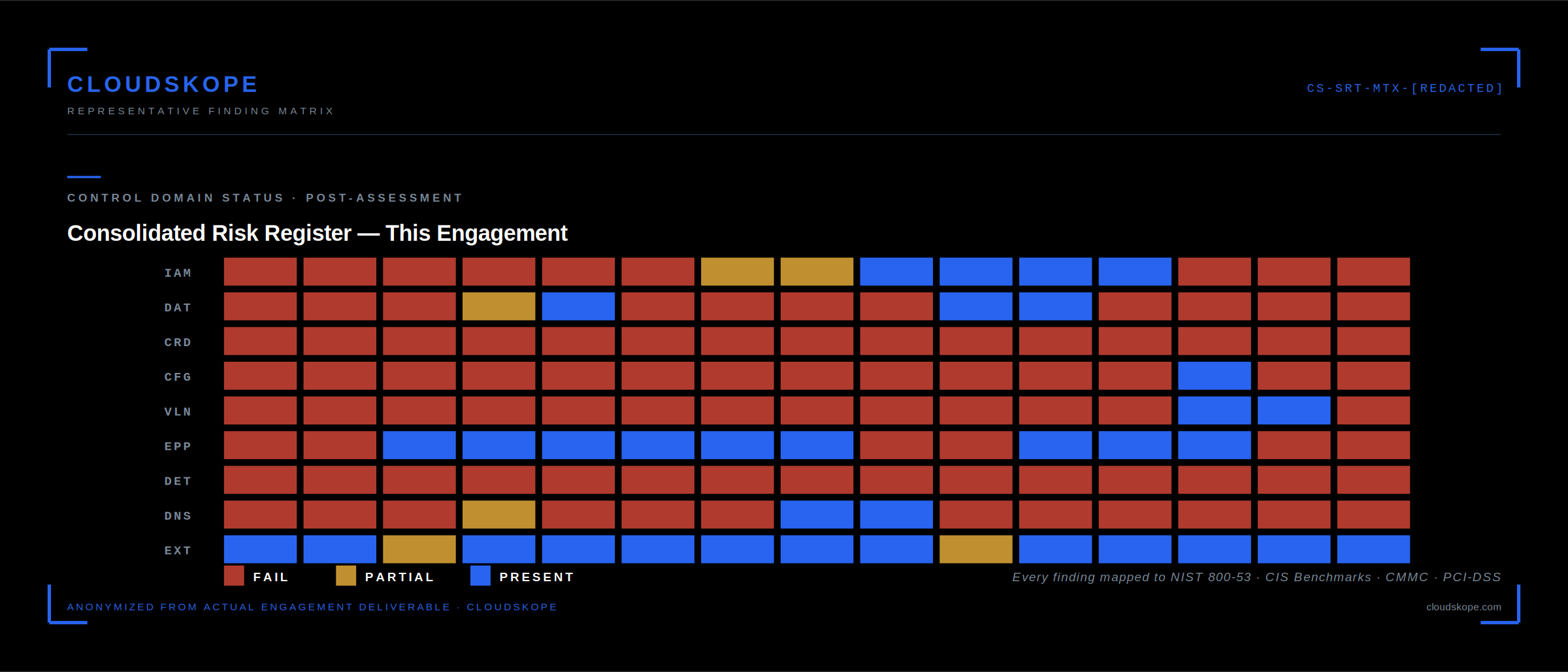
Every finding, open and closed, outlined, prioritized, and mapped to control frameworks. NIST SP 800-53 and CIS Benchmarks anchor every register as the universal baseline. Six technical overlays (NIST SP 800-171, CMMC, PCI DSS, CISA SCuBA, MCSB, and NSA hardening guidance) are layered in based on your regulatory footprint. Four attestation frameworks (SOC 2, ISO 27001, HIPAA Security Rule, and NIST CSF 2.0) are crosswalked so your auditor or certification body can work from the same evidence. Residual risk, insurability posture, and a recommended forward roadmap translated from technical record into business terms.
A compliance-ready artifact for auditors, underwriters, and counterparties. The register survives a board meeting, a cyber-insurance renewal, and a diligence buyer’s technical reviewer because it names what was closed, what remains, and what it will take to close the rest.
Full Prioritized Risk Register
NIST 800-53 & CIS Baseline; 800-171, CMMC, PCI, SCuBA, MCSB, NSA Overlays; SOC 2, ISO 27001, HIPAA, CSF Crosswalks
Residual-Risk Analysis
Insurability Posture Review
Recommended Forward Roadmap
The Difference
Most assessments hand you a PDF. SARTUS™ closes what’s closable.
Three business days of engineer-led remediation across configuration, identity, policy, and administrative controls, under your change control, executed before you receive the report. The part every other vendor scopes as a separate engagement is included in the fixed fee.
Beyond SARTUS™
A serious engagement should not end in a report that sits on a shelf. It should change what leadership can defend, what auditors can verify, and what buyers can price.

Ground Truth Established
Leadership has evidence, not belief. Every finding is timestamped, sourced, and defensible in front of a board or an underwriter.
Findings Actually Closed
Remediation is delivered, not just recommended. What can be closed in three days is closed. What cannot is documented with a real path forward.
Board-Defensible Artifact
The NIST 800-53 and CIS-mapped risk register survives a board meeting, a cyber-insurance renewal, and a diligence buyer’s technical reviewer.
Path Forward Priced
Structural work (new hardware, new licensing, network re-architecture) is quoted separately with real numbers, not “TBD.”
Ready to see this in your environment?
Six days. Fixed fee. Assessment plus remediation.
Talk to an AdvisorFrequently Asked Questions
Answers to the most common questions about SARTUS™ scope, process, boundaries, and what the deliverables actually enable.
What Happens Next
Every SARTUS™ engagement is scoped to your environment, priorities, and the deliverables you need after remediation closes. The engagement is time-bound: three business days of assessment, three business days of remediation, executive readout on the following week.
A Simple Path from Discovery to Closure

Kickoff
Scope confirmation, escalation contacts, and provisioning of least-privilege, read-only assessor access.

Assess
Three business days across four parallel workstreams. Any indicator of active compromise is escalated to leadership on discovery.

Remediate
Approved remediation queue executed in three business days under customer-approved change control.
Readout
Executive briefing with the consolidated risk register, residual-risk analysis, and recommended forward roadmap.
Not ready to talk yet? Check your tenant first.
Get the 7 signs your Microsoft 365 is already compromised, and where to check each one.
The checklist by email, plus a few short follow-ups. Unsubscribe anytime. Privacy policy
Assessment. Closure. Evidence. In six days.
If your organization has never formally answered where are we exposed, are we already compromised, and who is going to fix it, SARTUS™ answers all three in one engagement, in one week, at one fixed fee.
Contact us for current availability