The next major breach inside your company may not begin with ransomware, malware, or a firewall failure. It may begin with an employee connecting an AI tool to a corporate account and clicking “Allow.” That is the lesson executives should take from the Vercel breach.
The Vercel Breach Was Not an AI Story. It Was a Governance Story
The Vercel breach will likely be remembered as one of the clearest early warning signs of the next phase of enterprise cyber risk.
Not because of the size of the company.
Not because of the attacker’s claim.
Not because of the specific platform involved.
The real significance is that the incident exposed a structural weakness now present across thousands of organizations: employees are connecting AI tools, SaaS applications, browser extensions, productivity platforms, and developer services into the enterprise without the governance, visibility, or control maturity those integrations require.
According to Vercel’s own security bulletin, the incident originated with the compromise of Context.ai, a third-party AI tool used by a Vercel employee. The attacker used that access to take over the employee’s Google Workspace account, gain access to the employee’s Vercel account, pivot into a Vercel environment, and enumerate/decrypt non-sensitive environment variables. Vercel assessed the actor as highly sophisticated and said it was working with Google Mandiant, cybersecurity firms, industry peers, law enforcement, and Context.ai.
That sequence should matter to every CEO, CISO, CIO, COO, CFO, and board member.
Because this was not a classic perimeter failure.
It was not a simple password issue.
It was not a traditional vendor breach in the old sense.
It was a delegated trust failure.
An employee connected a third-party AI tool. That tool was compromised. The attacker inherited a path into a corporate workspace. From there, the incident moved into identity, SaaS, infrastructure, developer environments, and potentially customer-impacting secrets.
This is what modern enterprise risk now looks like.
It is fast. It is federated. It is permission-based. And in many companies, it is largely invisible to leadership until after the blast radius becomes clear.
OAuth permissions are becoming invisible infrastructure. If executives cannot see them, govern them, and revoke them quickly, they are already part of the company’s risk surface.
The New Enterprise Attack Surface Is Not Where Most Leaders Think It Is
For two decades, security programs were built around a familiar mental model: endpoints, networks, firewalls, email gateways, servers, and cloud workloads.
Those still matter.
But the Vercel incident shows that the modern enterprise attack surface now extends into a different layer:
- AI tools connected through corporate accounts
- OAuth grants approved by individual users
- Google Workspace and Microsoft 365 integrations
- SaaS applications outside procurement review
- Developer platforms connected to deployment workflows
- Environment variables, API keys, database strings, and access tokens
- Browser sessions and third-party extensions
- Low-code tools and automation platforms
- Contractor access and abandoned app trials
- “Temporary” integrations that become permanent exposure
This is the operational reality of the AI-enabled enterprise.
The issue is not that employees are malicious. The issue is that modern tools make it easy for well-intentioned employees to create material access pathways without realizing it.
A user does not need to be an administrator to introduce risk.
They may only need to connect an app.
That is what makes this category of exposure so dangerous.
Traditional security programs often treat SaaS app consent as a convenience feature. In reality, OAuth access can become a durable, privileged trust relationship between the company and an external service.
Trend Micro’s analysis of the Vercel incident highlights this point directly: OAuth applications can maintain persistent access tokens, do not require the user’s password, may survive password rotations, often carry broad scopes, and are rarely audited after initial authorization.
That is the enterprise blind spot.
A company can enforce MFA, harden endpoints, deploy EDR, implement email filtering, and still miss the fact that a third-party app has been granted broad access to corporate data.
This is why OAuth must now be treated as a control plane.
Not a user convenience.
Not a developer shortcut.
Not an IT afterthought.
A control plane.
Why This Matters to Executives
The Vercel breach belongs in the boardroom because it illustrates five executive-level risk themes.
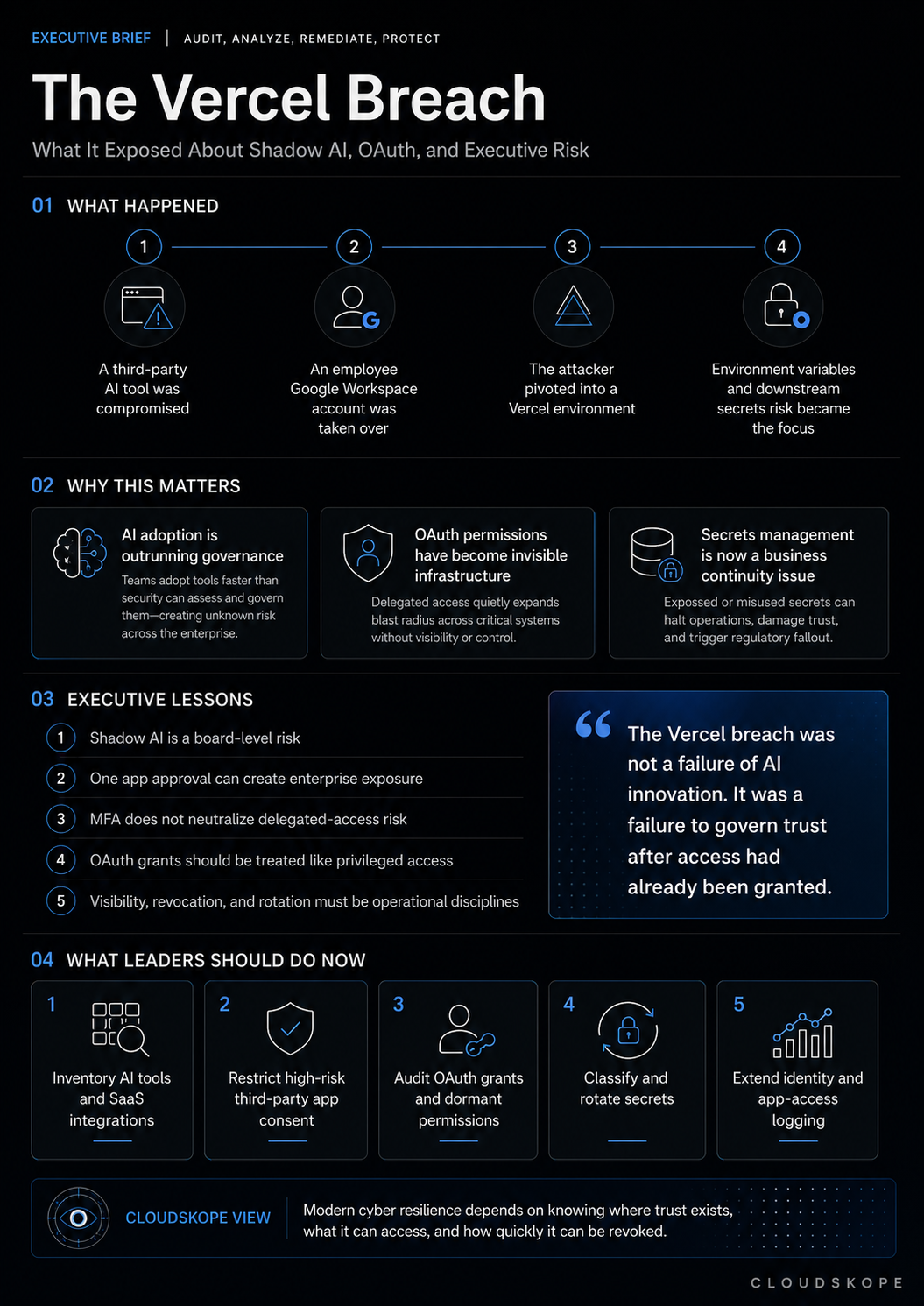
1. AI Adoption Has Outpaced AI Governance
Most organizations are adopting AI through the side door.
Employees experiment with tools before legal, IT, procurement, compliance, or security teams fully understand what has been connected.
This creates a dangerous governance gap.
The executive team may have an AI policy. But if the company does not have a real-time inventory of AI tools connected to corporate systems, the policy is largely theoretical.
Boards should not ask, “Do we allow AI?”
They should ask:
“Which AI tools have access to our identity layer, email, files, source code, customer data, and business systems?”
That is a very different question.
2. OAuth Is Becoming the New Shadow IT
Shadow IT used to mean unsanctioned software.
Now it means unsanctioned permissions.
An employee may not install anything on a laptop. They may not bypass an endpoint agent. They may not download malware.
They may simply authorize a SaaS application.
That authorization may expose email, calendars, files, contacts, documents, repositories, tokens, or downstream systems.
Google Workspace gives administrators mechanisms to trust, limit, or block app access, including app-level controls through API Controls. But the existence of a control is not the same as control maturity.
The executive question is not whether the platform supports the setting.
The question is whether the company has configured it, audited it, tested it, and assigned ownership.
3. Secrets Management Is Now a Business Continuity Issue
Vercel specifically advised users to review and rotate environment variables that were not marked as sensitive, including API keys, tokens, database credentials, and signing keys. Vercel also warned that deleting projects or accounts is not sufficient because compromised secrets may still provide access to production systems.
That is a critical point.
Credentials are not just technical artifacts.
They are operational dependencies.
A leaked API key can affect revenue systems.
A leaked database credential can affect customer trust.
A leaked signing key can undermine application integrity.
A leaked deployment token can compromise production.
In a well-governed company, secrets should be inventoried, classified, rotated, monitored, and mapped to business impact.
In many companies, they are scattered across developer environments, CI/CD pipelines, SaaS platforms, configuration files, spreadsheets, and forgotten admin consoles.
That is not a security issue alone.
That is operational fragility.
4. Third-Party Risk Has Become Continuous, Not Periodic
The traditional vendor-risk model was built for annual questionnaires, SOC 2 reviews, procurement checklists, and contract language.
That model is insufficient for AI-enabled SaaS.
A tool can be adopted today, connected to corporate identity today, granted broad access today, and compromised tomorrow.
The risk cycle has compressed.
Third-party risk cannot remain a once-a-year paperwork exercise. It must become a continuous control function connected to identity, access, data classification, app inventory, and incident response.
The Vercel incident also shows why “we are not a customer” is no longer a clean defense. Push Security noted that Context.ai reportedly was not a formal Vercel customer relationship in the traditional sense, yet a Vercel employee had connected the tool into the environment.
That is the point.
Vendor risk now includes tools your employees use before procurement knows they exist.
5. Boards Need Better Questions
Most boards still ask security questions that are too broad:
- Are we secure?
- Do we have MFA?
- Do we have endpoint protection?
- Are we using AI safely?
- Do we have cyber insurance?
Those questions are insufficient.
After Vercel, board-level questioning needs to become more precise:
- Which AI tools are connected to our corporate identity environment?
- Which OAuth apps have access to email, files, code, customer data, or administrative functions?
- Can employees grant broad third-party app permissions without approval?
- How often do we audit OAuth grants?
- Can we revoke all access from a compromised third-party app within one hour?
- Which secrets are exposed in developer environments?
- Which environment variables are classified as sensitive?
- How quickly can we rotate credentials across production systems?
- Do our logs retain enough detail to investigate OAuth-based access?
- Who owns the business risk when a third-party AI app creates enterprise exposure?
These are governance questions.
They belong with executive leadership.
The Executive Control Model: What Leaders Should Do Now
The Vercel breach should not drive panic.
It should drive structured action.
CloudSkope recommends that executives treat this as an opportunity to run a focused exposure audit across AI tools, SaaS integrations, identity controls, developer secrets, and third-party access.
The objective is not to eliminate innovation.
The objective is to govern it.
“The Vercel breach was not a failure of AI innovation. It was a failure to govern trust after access had already been granted.”
1. Create an AI and SaaS Access Inventory
Every organization should know which AI tools and SaaS applications are connected to corporate systems.
This inventory should include:
- Application name
- Owner
- Business purpose
- User count
- Authentication method
- OAuth scopes requested
- Data accessible
- Administrative privileges
- Vendor status
- Approval status
- Renewal or review date
- Risk rating
- Revocation plan
The inventory should not be limited to formally procured tools.
It should include self-service trials, browser extensions, developer utilities, no-code platforms, AI assistants, and apps authorized through Google Workspace or Microsoft 365.
2. Restrict User Consent for High-Risk Apps
Executives should ask whether ordinary users can grant broad third-party access without review.
In many environments, the answer is still yes.
That is a governance failure.
For Google Workspace, administrators can manage third-party app access and classify apps as Trusted, Limited, Specific Google Data, or Blocked. For more mature environments, Context-Aware Access can further condition access based on user identity, device security status, IP address, and geography.
Microsoft 365 environments need a similar review of enterprise app consent, delegated permissions, admin consent workflows, service principals, and app registrations.
The policy principle is simple:
Employees should not be able to grant material enterprise access to unreviewed applications.
3. Treat OAuth Grants as Privileged Access
OAuth grants should be reviewed with the same seriousness as privileged accounts.
Organizations should monitor:
- New third-party app authorizations
- High-risk OAuth scopes
- Apps requesting email or file access
- Apps requesting offline access
- Apps used by executives or administrators
- Apps connected by developers
- Dormant apps with active permissions
- Apps with no clear business owner
- Consent activity outside normal geographies or devices
OAuth should be part of the identity governance program, not a footnote in SaaS administration.
4. Classify and Rotate Secrets
The Vercel incident reinforces the importance of secrets governance.
Every organization should know where sensitive values live and how quickly they can be rotated.
At minimum, companies should inventory and classify:
- API keys
- Database credentials
- Signing keys
- Deployment tokens
- Webhooks
- Cloud provider keys
- SaaS tokens
- CI/CD secrets
- Environment variables
- Service-account credentials
Vercel’s own recommendations included rotating environment variables not marked sensitive, using sensitive environment variable features, reviewing activity logs, investigating deployments, and rotating deployment protection tokens where applicable.
The broader lesson is platform-neutral: secrets must be treated as critical assets.
5. Increase Log Retention and Investigation Readiness
OAuth-based attacks often use legitimate access patterns. That makes them harder to detect than noisy malware events.
Executives should ask:
- How long are identity and OAuth logs retained?
- Can we reconstruct third-party app access over the last 90, 180, or 365 days?
- Can we identify which data an app accessed?
- Can we determine whether access occurred from unusual IPs, devices, geographies, or user agents?
- Can we correlate app consent with downstream activity in SaaS, cloud, and developer platforms?
Trend Micro noted that Google Workspace OAuth audit logs are retained for six months by default on many subscription tiers and that longer-running compromises could outlast default retention.
That is a board-level issue because insufficient logs turn an incident into an unresolved liability.
6. Build an AI Governance Operating Model
Most companies do not need another AI policy.
They need an AI operating model.
A practical model should define:
- Approved AI use cases
- Prohibited data types
- Approved tools
- App-review workflow
- Legal and procurement review triggers
- Data-retention requirements
- Identity and OAuth controls
- Monitoring requirements
- Incident-response process
- Board reporting metrics
AI governance should not be positioned as a blocker to innovation. It should be positioned as the control framework that allows safe adoption at enterprise speed.
NIST CSF 2.0 is useful here because it explicitly places Govern at the center of cyber risk management and applies the framework to cloud, mobile, and artificial intelligence systems.
The lesson is clear: AI risk is not just a technical discipline. It is a governance discipline.
The CloudSkope View
The Vercel breach should become a decision point for executive teams.
Companies can treat it as another news cycle, or they can treat it as a live-fire case study in how modern enterprise exposure actually forms.
The better response is not panic.
The better response is an audit.
An audit of AI tools.
An audit of OAuth permissions.
An audit of SaaS integrations.
An audit of developer secrets.
An audit of Microsoft 365 and Google Workspace app consent.
An audit of third-party access.
An audit of whether the company can actually revoke, rotate, investigate, and recover when delegated trust fails.
This is the difference between a company that owns cyber risk and a company that inherits it.
Modern cyber resilience is no longer about having more tools.
It is about knowing where trust exists, who granted it, what it can access, how it is monitored, and how quickly it can be revoked.
The Vercel breach was not an anomaly.
It was a preview.
Related Reading
The executive lesson from the Vercel breach is simple: AI adoption without identity governance creates unmanaged enterprise risk. The companies that win the next phase of cybersecurity will not be the ones that ban AI, overload employees with policies, or buy another disconnected tool. They will be the companies that govern trust. They will know which tools are connected, which permissions exist, which secrets matter, which vendors create material exposure, and which controls can be executed under pressure. For leadership teams, the action item is immediate: Do not wait for a breach to discover which AI tools and SaaS applications have access to your company. Audit them now.


.png)