The Frost Bank headlines are not only about banking. They are about a larger shift in enterprise cyber risk: the boundary between your company and your vendors no longer protects your reputation. When customer data is exposed, the market does not care whose network was compromised first.
Vendor Risk Is No Longer a Back-Office Compliance Exercise
For years, third-party risk management was treated as an annual documentation exercise.
Collect the questionnaire. Review the SOC report. Confirm the vendor has policies. File the evidence. Repeat next year.
That model is no longer sufficient.
Recent reporting states that Frost Bank is facing proposed class-action lawsuits following an alleged breach involving a third-party vendor, with more than 100,000 customers reportedly affected. Frost reportedly said there was no evidence of unauthorized access to its own network, while the lawsuits allege sensitive customer information may have been exposed and that notification delays increased customer risk.
That distinction matters.
It also may not matter enough.
Because customers experience the outcome, not the internal control boundary.
If their Social Security number, financial information, contact details, or identity data is exposed, they are unlikely to separate “our vendor had the issue” from “our institution failed to protect me.”
That is the new vendor-risk reality.
Third-party risk has become first-party accountability. A vendor breach may originate outside your network, but the legal, reputational, and customer-trust consequences still land with your brand.
Why “Our Network Was Not Compromised” Is No Longer Enough
The phrase “our network was not compromised” may be technically important. It can clarify scope. It may help investigators. It may matter in litigation.
But it is no longer enough as an executive risk defense.
A modern organization’s operating model depends on vendors, SaaS platforms, payment processors, cloud providers, data platforms, managed service providers, analytics tools, and outsourced business workflows.
Those vendors often touch sensitive information or critical business processes.
That means the trust boundary has expanded.
If a vendor can access your data, process your customer information, support your systems, or operate inside your workflow, then that vendor is part of your risk surface.
In the Frost reporting, one lawsuit estimated roughly 109,000 people may have been affected, and Texas law generally requires certain breach reports within 30 days when at least 250 residents are affected.
That creates immediate executive questions:
- Which vendors have sensitive data?
- Which vendors have privileged access?
- Which vendors create customer-impacting exposure?
- Which contracts require notification and cooperation?
- Which vendors could create litigation or regulatory exposure if breached?
The old model asked, “Did the vendor complete our questionnaire?”
The new model asks, “Can we prove vendor trust is governed continuously?”
What Executives Should Learn
The Frost case reinforces five lessons for boards and leadership teams.
“In modern cyber risk, ‘our network was not compromised’ is no longer a defense when customers experience the breach as yours.”
1. Third-Party Risk Is First-Party Accountability
When a vendor fails, the business still owns the customer relationship.
That means leaders must govern vendor exposure as part of enterprise risk, not merely procurement.
2. Vendor Incidents Can Become Board-Level Events
A vendor breach can trigger legal exposure, regulatory scrutiny, media attention, customer churn, and operational distraction.
That is board-level material.
3. Notification Delays Amplify Damage
Speed matters.
Delays can reduce customer ability to act, increase frustration, and weaken trust.
4. Customer Trust Erodes Faster Than Litigation Resolves
Legal processes move slowly. Customer trust can move instantly.
A well-governed response must address both.
5. Annual Questionnaires Are Not Enough
Vendor trust must be monitored, tested, and governed continuously.
A mature program should include:
- vendor inventory,
- data-flow mapping,
- access reviews,
- contractual notification obligations,
- audit rights,
- incident escalation paths,
- tabletop exercises,
- and risk-based monitoring.
Related Executive Analysis
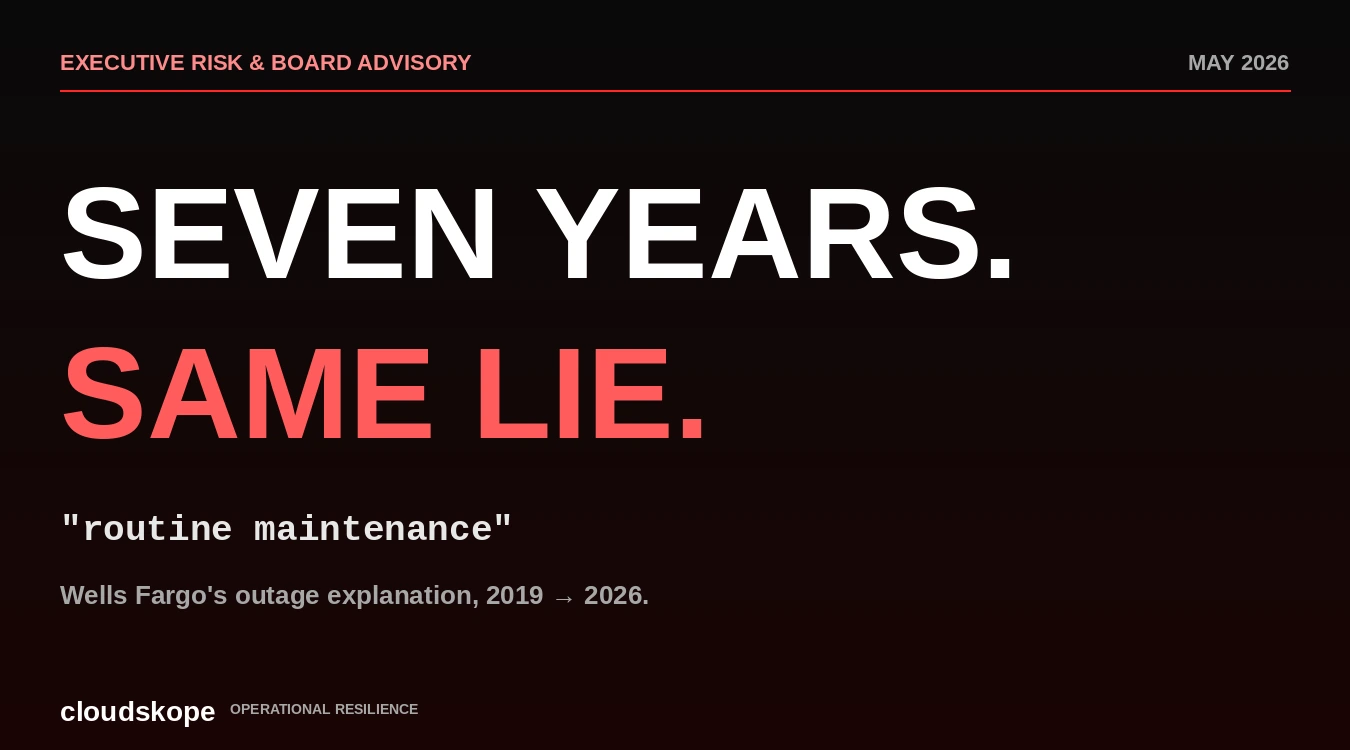
The Frost Bank case is a vendor-breach failure on the data side. The operational counterpart — vendor concentration risk that produces customer-impacting outages without a hostile actor — has its own multi-year case study at the same scale.
- Seven Years. Five Major Outages. Wells Fargo Still Calls It "Routine Maintenance." — the operational dimension of the new vendor-risk reality, with the same governance question Frost surfaces: when does vendor language stop describing operational reality?
- What is Vendor Risk Management? — the foundational discipline behind continuous vendor governance.
Third-party risk is no longer a secondary control function. It is a core component of enterprise resilience. The Frost Bank matter should prompt every executive team to review whether their organization knows which vendors have sensitive access, which relationships create material exposure, and how fast the business can respond if a vendor-linked incident occurs. The organizations that lead on cyber resilience will not be the ones with the longest questionnaires. They will be the ones that govern vendor trust continuously.
Cloudskope provides vendor risk management and third-party cyber due diligence for boards, mid-market enterprises, and PE operating partners — including continuous monitoring, contractual controls, and the incident-readiness work most organizations have not formally inventoried across their full SaaS, banking, and managed-service vendor stack.


.png)
.png)