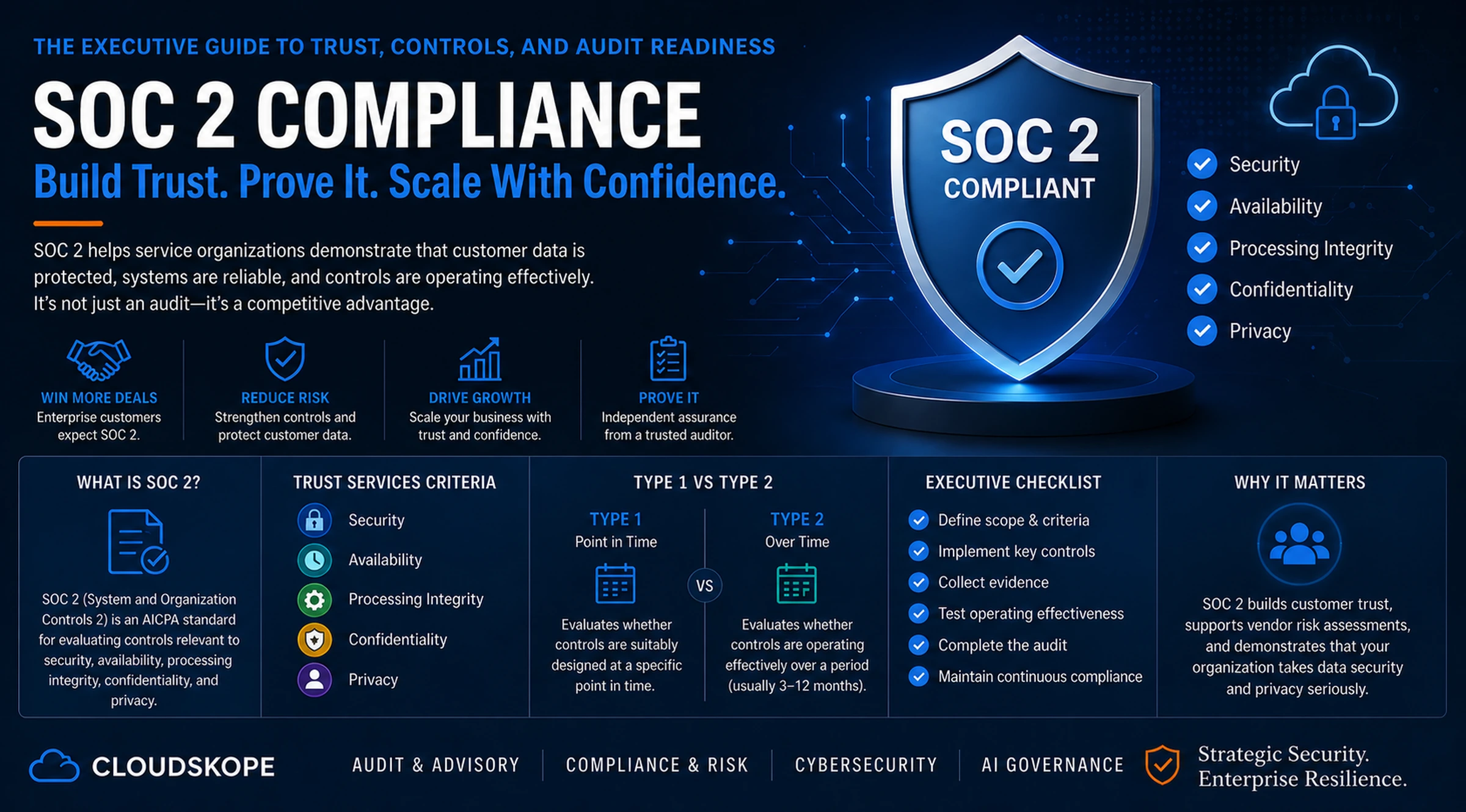
SOC 2 is one of the most searched, misunderstood, and commercially important cybersecurity frameworks in the market. Customers ask for it. Vendors use it to prove trust. Procurement teams rely on it. Boards view it as evidence of control maturity. And growth-stage companies often discover its importance only after a major deal stalls in security review. SOC 2 is not merely an audit. It is a way to prove that your company can protect customer data, operate critical systems responsibly, and sustain trust at enterprise scale.
What Is SOC 2 Compliance?
SOC 2 stands for System and Organization Controls 2. It is an independent attestation report developed by the American Institute of Certified Public Accountants, commonly known as the AICPA, to evaluate controls at service organizations.
In plain English, SOC 2 helps answer a buyer’s most important trust question:
Can this company protect our data and operate its systems responsibly?
The AICPA describes SOC 2 as a report on controls at a service organization relevant to security, availability, processing integrity, confidentiality, or privacy. SOC 2 reports are intended for users who need detailed information and assurance about those controls.
That is why SOC 2 matters so much for SaaS companies, cloud providers, fintech platforms, managed service providers, data processors, technology firms, and any organization that stores, processes, transmits, or supports customer data.
A strong SOC 2 program tells customers:
- You have defined security controls.
- You know who can access customer data.
- You monitor your systems.
- You manage vendors.
- You assess risk.
- You respond to incidents.
- You document evidence.
- You operate controls consistently over time.
That last point is critical.
SOC 2 is not simply about having policies. It is about proving that the business operates with control discipline.
SOC 2 is not just a compliance badge. It is a trust operating model that converts cybersecurity controls into customer confidence, sales velocity, and executive accountability.
Why SOC 2 Compliance Matters
SOC 2 matters because trust has become a buying requirement.
In B2B markets, customers increasingly expect vendors to prove security maturity before signing contracts, sharing data, granting system access, or renewing strategic relationships. A-LIGN describes SOC 2 as an industry standard for service organizations, especially SaaS companies, data centers, and MSPs, and notes that a SOC 2 report is often considered a cost of doing business because it establishes trust, supports revenue, and unlocks opportunities.
That aligns with what many growth companies experience in the market.
A prospect may love your product.
The champion may be ready to buy.
The business case may be clear.
Then procurement asks for your SOC 2 report.
If you do not have one, the deal may slow down, move to a competitor, or become buried in a long security questionnaire.
SOC 2 helps companies reduce that friction.
It can support:
- enterprise sales,
- vendor onboarding,
- customer trust,
- renewal confidence,
- insurance conversations,
- board reporting,
- privacy governance,
- and security maturity.
The University of Tulsa’s overview also notes that SOC 2 reports can help with vendor management, organizational oversight, risk management, and regulatory oversight.
That is the executive lens.
SOC 2 is not only about passing an audit. It is about demonstrating that the organization can be trusted with systems and data.
What Does SOC 2 Stand For?
SOC 2 stands for System and Organization Controls 2.
It is part of the broader SOC reporting family:
- SOC 1 focuses on controls relevant to financial reporting.
- SOC 2 focuses on controls relevant to security, availability, processing integrity, confidentiality, and privacy.
- SOC 3 is a public-facing, less detailed report based on SOC 2 that can be shared broadly for marketing and trust purposes.
A-LIGN explains the difference clearly: SOC 1 addresses internal controls over financial reporting, while SOC 2 focuses more broadly on information and IT security.
For most technology and data-driven companies, SOC 2 is the report customers ask for when they want assurance around cybersecurity, data protection, and operational control maturity.
SOC 2 Trust Services Criteria
SOC 2 is organized around five Trust Services Criteria:
- Security
- Availability
- Processing Integrity
- Confidentiality
- Privacy
The AICPA identifies SOC 2 as covering controls relevant to these five categories. Secureframe and Optro both explain that Security is the baseline category, while the other categories may be added depending on the company’s services, customer needs, data types, and risk profile.
1. Security
Security is the required category for every SOC 2 report.
It addresses whether systems and information are protected against unauthorized access, unauthorized disclosure, and damage that could affect availability, integrity, confidentiality, privacy, or business objectives.
Common security controls include:
- identity and access management,
- MFA,
- logging and monitoring,
- risk assessment,
- vendor management,
- vulnerability management,
- endpoint security,
- change management,
- incident response,
- security awareness training,
- and configuration management.
2. Availability
Availability focuses on whether systems are available for operation and use as committed or agreed.
This matters for companies where uptime, continuity, capacity, and disaster recovery are important to customers.
Typical control areas include:
- backup and recovery,
- uptime monitoring,
- capacity planning,
- disaster recovery,
- incident escalation,
- and business continuity.
3. Processing Integrity
Processing Integrity focuses on whether system processing is complete, valid, accurate, timely, and authorized.
This is especially relevant for companies handling transactions, calculations, workflows, data pipelines, claims, billing, or automated decisioning.
4. Confidentiality
Confidentiality focuses on whether confidential information is protected according to commitments and requirements.
This applies to companies that handle sensitive business data, customer information, intellectual property, legal records, financial information, or proprietary datasets.
5. Privacy
Privacy focuses on whether personal information is collected, used, retained, disclosed, and disposed of according to privacy commitments and applicable requirements.
This becomes especially relevant for companies processing personally identifiable information, healthcare data, financial data, or regulated personal information.
SOC 2 Type 1 vs Type 2
One of the most important SOC 2 decisions is whether to pursue a Type 1 or Type 2 report.
SOC 2 Type 1
A SOC 2 Type 1 report evaluates whether controls are suitably designed at a specific point in time.
It answers the question:
Do the controls exist and are they designed appropriately today?
A Type 1 report can be useful when:
- the company is early in its compliance journey,
- customers need an initial trust signal,
- the organization needs to establish baseline controls,
- or leadership wants a readiness milestone before moving into Type 2.
SOC 2 Type 2
A SOC 2 Type 2 report evaluates whether controls are designed and operating effectively over a defined period of time.
It answers the question:
Do the controls actually work over time?
A-LIGN notes that Type 2 reports usually evaluate controls over a period of 3 to 12 months and provide a greater level of trust because they give more visibility into operating effectiveness. Secureframe similarly explains that Type 1 evaluates whether controls are properly designed, while Type 2 assesses whether controls function as intended over time.
For enterprise buyers, Type 2 is often the more meaningful report.
It shows sustained control maturity, not just point-in-time readiness.
SOC 2 Compliance Requirements
SOC 2 requirements vary by organization because the framework is flexible. Unlike some highly prescriptive standards, SOC 2 allows companies to design controls that fit their systems, services, commitments, and selected Trust Services Criteria.
That flexibility is valuable, but it also creates risk.
Companies sometimes underestimate the work required because SOC 2 does not provide one simple universal checklist.
At a minimum, most SOC 2 programs should address:
Governance and Risk Management
- documented security program,
- executive ownership,
- policies and procedures,
- risk assessments,
- control ownership,
- and recurring management review.
Identity and Access Management
- MFA,
- user access reviews,
- privileged access controls,
- onboarding and offboarding,
- role-based access,
- service account governance,
- and access logging.
Infrastructure and Cloud Security
- asset inventory,
- secure configuration,
- vulnerability management,
- patch management,
- endpoint protection,
- cloud security controls,
- logging and monitoring,
- and backup controls.
Change Management
- documented change process,
- approval workflows,
- testing evidence,
- production deployment controls,
- rollback procedures,
- and separation of duties where appropriate.
Vendor Management
- third-party risk reviews,
- vendor inventory,
- critical vendor classification,
- contract review,
- security evidence collection,
- and periodic reassessment.
Incident Response
- incident response plan,
- escalation procedures,
- evidence retention,
- tabletop testing,
- breach notification workflows,
- and post-incident review.
Data Protection
- data classification,
- encryption,
- retention rules,
- secure disposal,
- confidentiality controls,
- privacy commitments,
- and data access restrictions.
Optro’s SOC 2 guide notes several recurring control activities, including maintaining an information security program, conducting risk assessments, vendor reviews, access management, asset inventory, data classification, vulnerability scanning, incident response testing, and logging and monitoring.
SOC 2 Audit Process
A typical SOC 2 journey includes six phases.
1. Scope the Report
Define:
- which product or service is in scope,
- which systems support it,
- which locations and teams are included,
- which Trust Services Criteria apply,
- and which customer commitments must be addressed.
This is where many companies go wrong. A poorly scoped SOC 2 report can create audit friction, customer confusion, or unnecessary control burden.
2. Perform a Readiness Assessment
A readiness assessment identifies gaps before the formal audit.
This should include:
- policy review,
- access control review,
- cloud configuration review,
- vendor-risk review,
- incident response review,
- control mapping,
- and evidence-readiness testing.
3. Remediate Control Gaps
Common remediation areas include:
- missing policies,
- incomplete access reviews,
- weak vendor oversight,
- lack of vulnerability management evidence,
- insufficient logging,
- poor change-management documentation,
- and untested incident response plans.
4. Collect Evidence
Auditors need evidence that controls are designed and, for Type 2, operating effectively.
Evidence may include:
- screenshots,
- logs,
- tickets,
- approvals,
- reports,
- policies,
- access reviews,
- training records,
- vendor reviews,
- incident response tests,
- and vulnerability scan results.
5. Complete the External Audit
An independent CPA firm performs the audit and issues the report.
The University of Tulsa overview notes that service organizations hire external certified public accountants to conduct SOC 2 audits, helping ensure independence and alignment with applicable auditing standards.
6. Operationalize Continuous Compliance
The best companies do not treat SOC 2 as a once-a-year scramble.
They turn it into an operating rhythm:
- monthly control checks,
- quarterly access reviews,
- recurring vendor reviews,
- annual risk assessments,
- ongoing vulnerability management,
- periodic tabletop exercises,
- and board-visible security reporting.
SOC 2 Audit Cost
SOC 2 audit cost varies widely depending on:
- company size,
- audit scope,
- number of Trust Services Criteria,
- Type 1 vs Type 2,
- number of systems,
- number of locations,
- auditor selection,
- evidence readiness,
- remediation needs,
- and whether a readiness assessment is performed first.
From an executive standpoint, the better question is not only:
How much does SOC 2 cost?
The better question is:
What is the cost of not being ready when a strategic customer asks for it?
A delayed SOC 2 effort can slow enterprise sales, increase security questionnaire burden, weaken competitive positioning, and create operational fire drills.
SOC 2 Checklist for Executives
Use this as a board-level SOC 2 readiness checklist.
Strategy
- Define why SOC 2 matters to the business.
- Identify customer and contract drivers.
- Decide whether Type 1 or Type 2 is appropriate.
- Select relevant Trust Services Criteria.
- Assign an executive owner.
Scope
- Identify in-scope products and services.
- Map systems, vendors, data flows, and teams.
- Define customer commitments.
- Document boundaries and exclusions.
Controls
- Implement access management.
- Enforce MFA.
- Maintain asset inventory.
- Review privileged access.
- Conduct vulnerability management.
- Monitor systems and logs.
- Test incident response.
- Manage vendors.
- Document change management.
- Maintain security policies.
Evidence
- Create evidence owners.
- Define evidence cadence.
- Store evidence centrally.
- Review evidence quality before audit.
- Track remediation to closure.
Governance
- Report readiness to leadership.
- Track exceptions.
- Update risk register.
- Review control failures.
- Maintain continuous compliance.
Related Reading
SOC 2 is one of the most important trust frameworks for modern service organizations. For buyers, it provides assurance. For vendors, it accelerates trust. For executives, it translates cybersecurity into operational discipline, customer confidence, and market credibility. But SOC 2 only creates value when it is approached correctly. A rushed SOC 2 effort can produce audit fatigue, weak controls, and poor evidence. A strategic SOC 2 program can improve security, strengthen governance, reduce sales friction, and create a repeatable control environment. The goal is not to “get SOC 2 done.” The goal is to build a company that can prove trust under scrutiny.
Schedule a SOC 2 Readiness and Control Assessment with CloudSkope to identify audit gaps, improve control maturity, prepare evidence, and build a scalable compliance program before customers, auditors, or enterprise buyers force the issue.