.png)


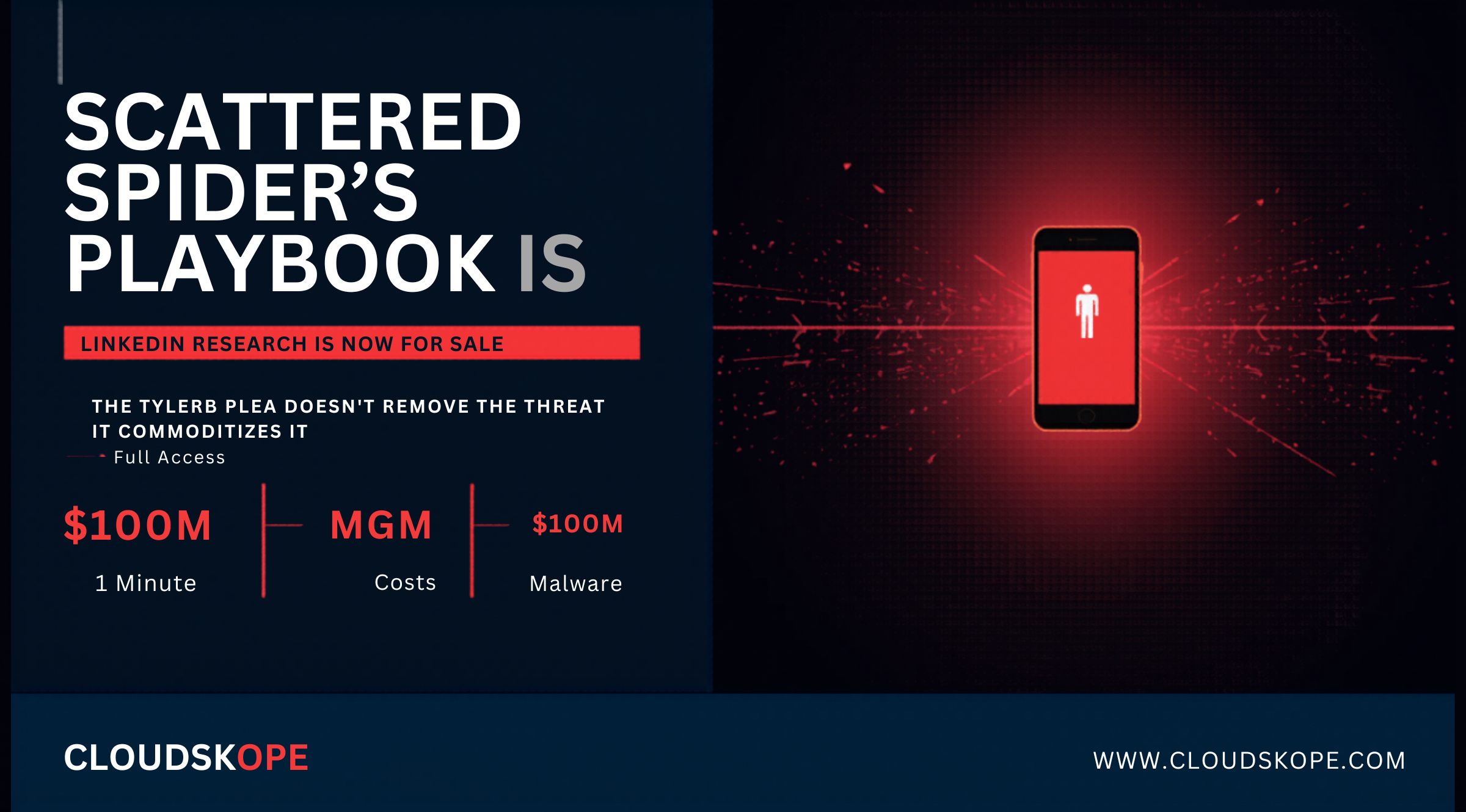
When sophisticated threat actors are arrested, organizations sometimes exhale. The attribution is confirmed. The perpetrators face consequences. The threat feels contained. Scattered Spider's arrest and guilty pleas deserve no exhale. The techniques that allowed a group of 19-to-24-year-olds to breach MGM Resorts, Caesars Entertainment, Okta, Twilio, MailChimp, and dozens of other organizations are not gone. They are documented, replicated, and for sale. What was a threat group capability in 2022 is a criminal market product in 2026.
Who Scattered Spider Was and What They Actually Did
Scattered Spider, tracked by security vendors as UNC3944 and Octo Tempest, operated between 2022 and 2024 with a methodology that turned the assumptions of enterprise security inside out. They did not exploit software vulnerabilities. They did not deploy sophisticated malware. They called people on the phone.
The Methodology: Social Engineering at Enterprise Scale
Scattered Spider's operational approach combined publicly available intelligence — LinkedIn, company websites, employee directories, breach databases — with real-time social engineering of corporate help desks and IT support staff. Their process was systematic: research the target organization's IT structure, identify employees with administrative access, obtain those employees' personal information from breach databases, and use that information to convincingly impersonate them when calling the help desk.
A typical engagement began with a LinkedIn search to identify an IT administrator or security team member. The attacker would locate that person's personal mobile number from a breach database and call the corporate help desk, present themselves as the administrator, claim they were locked out or traveling internationally without access to their authentication device, and request a password reset or MFA bypass. Most corporate help desks were not designed to resist this. Their verification procedures relied on knowledge factors — employee ID, last four digits of Social Security number, mother's maiden name — all of which are available in breach databases for the majority of the adult US population.
The MGM and Caesars Breaches: The Cases That Changed Boardroom Conversations
The 2023 MGM Resorts breach demonstrated the financial consequence of social engineering at scale. Attackers identified an MGM IT employee on LinkedIn, obtained their information, called the MGM help desk, and triggered an MFA reset. They then deployed ransomware across MGM's infrastructure. The recovery cost exceeded $100 million. Slot machines went offline. Hotel room keys stopped working. Reservation systems were unavailable for days. Caesars Entertainment's board chose to pay the ransom — approximately $15 million. The payment did not prevent the stolen data from being sold.
The Okta breach deserves specific attention because of its second-order effects. When Scattered Spider compromised Okta's customer support environment, they did not just breach Okta — they accessed customer tenants whose administrative configurations were visible through the support interface. Organizations that trusted Okta as their identity provider discovered that a social engineering attack on Okta's help desk had become a supply chain vector into their own environments.
Scattered Spider's arrests remove the perpetrators. They do not remove the playbook, which has been replicated across criminal networks, automated in phishing kits, and adapted for voice-cloning tools that make vishing indistinguishable from a legitimate colleague call.
Why the Playbook Is Now More Dangerous Without Scattered Spider
The criminal underground does not require a sophisticated threat group to maintain a technique once that technique has been documented and proven. Scattered Spider's methods have been discussed in hacker forums, replicated in commercial phishing kits, and described in security vendor reports with enough detail for a determined attacker to reconstruct the approach without any direct connection to the original group.
AI Voice Cloning Has Changed Vishing Permanently
In 2022, a vishing call from an attacker impersonating an IT employee was credible if the attacker was socially adept and had done their research. In 2026, a vishing call can be made using a voice clone of the actual employee — a synthetic voice trained on LinkedIn posts, company webinars, internal Zoom recordings, or any other audio content where the target's voice is publicly available. ElevenLabs, Resemble AI, and a growing number of commercial and open-source voice cloning tools can produce a convincing voice clone from as little as 30 seconds of source audio. The help desk agent who receives a call from their apparent colleague's voice, saying the words their colleague would say, asking for the kind of help their colleague might need, is now facing an attack that their social intuition cannot reliably detect.
Breach Data Has Made Identity Verification Obsolete
The knowledge factors that corporate help desks use to verify identity — employee ID numbers, the last four of a Social Security number, date of birth, previous address — are available in bulk breach datasets that can be purchased for trivial amounts on criminal markets. The breach databases from National Public Data, AT&T, Change Healthcare, and hundreds of smaller incidents contain enough personal information about the majority of US adults to answer any standard identity verification question. An attacker targeting a specific employee needs access to a breach database — which costs less than a monthly coffee subscription on criminal markets — and the patience to look up the target's information before making the call.
The Target Profile Has Expanded to Mid-Market
Scattered Spider's original target selection focused on large enterprises. Their success has expanded the target profile to mid-market organizations, where the defenses are typically weaker and the ROI for an attacker is still significant. A PE portfolio company at $100-300M revenue does not have MGM's security team. It has an IT department organized around uptime and support, not adversarial social engineering defense. Its help desk procedures were written before the Scattered Spider campaigns demonstrated how those procedures could be exploited.
What Boards and Operating Partners Need to Demand Right Now
The Tylerb plea is a prompt for every organization to review their help desk security procedures against a very specific question: if an attacker called your help desk right now with the voice of your CFO and the correct answers to your identity verification questions, would they get the MFA reset they asked for? For most mid-market organizations, the honest answer is yes. That is the action item.
Help desk identity verification procedures need to eliminate knowledge factors as the primary authentication mechanism. Date of birth, employee ID, and the last four of a Social Security number are not secrets in 2026. Verification must rely on something that cannot be obtained from a breach database: a cryptographic proof, a hardware token confirmation, a manager callback through a known-good communication channel, or a video verification step resistant to deepfake manipulation at current technology levels.
Organizations should implement a protocol for high-risk help desk actions — MFA resets, password resets for privileged accounts, device enrollment — that requires a callback to the user's registered corporate phone number, confirmation from the user's manager through a separate channel, and a delay period for any request received outside normal working hours or from an unfamiliar communication channel.
Vishing simulations — structured tests of help desk staff response to social engineering calls — should be on the security testing calendar for every organization that has not run one. The findings are consistently sobering. Security awareness training should include specific scenarios around vishing and voice clone attacks, because the attack is now uncomfortable enough during training to reduce complacency during an actual incident.
Related Reading
Tylerb's guilty plea is a legal milestone that does not reduce risk by a single percentage point for the organizations in Scattered Spider's expanded target profile. The techniques exist. The tools are available. The data needed to execute the attacks is for sale. The next group does not need Scattered Spider's leadership to execute Scattered Spider's playbook — they need a breach database subscription, a voice cloning subscription, and a phone.
Cloudskope's Cyber Risk Assessment includes vishing simulation and help desk security procedure review — evaluating your organization's actual response to social engineering attempts, not its policy documents. We identify the specific verification gaps that the Scattered Spider methodology exploits, and provide a remediation roadmap that does not depend on employees successfully detecting attacks their training did not prepare them for.