.png)


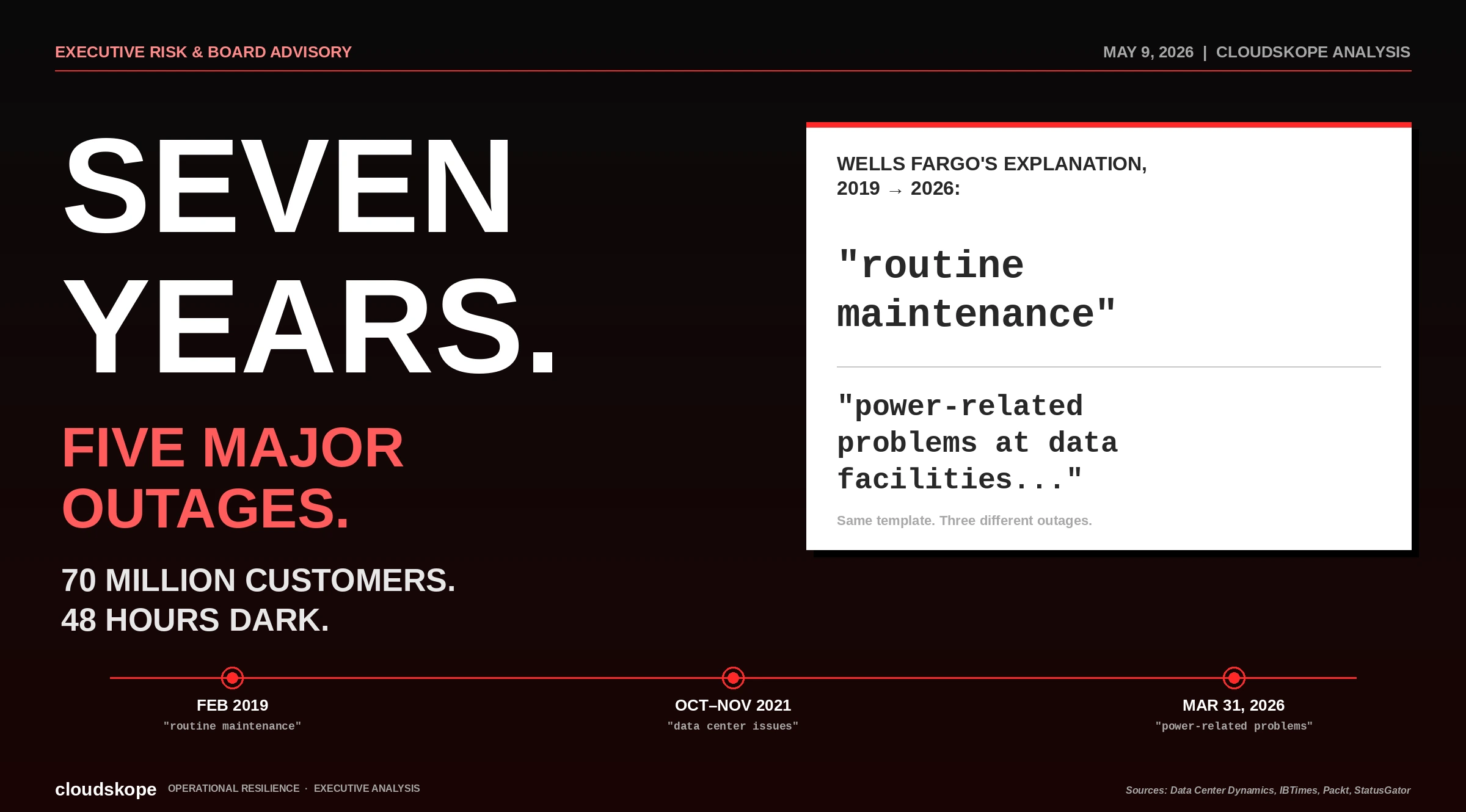
On March 31, 2026, Wells Fargo's online banking and mobile app went down nationwide. Customers reported login failures, transaction errors, and the same support-page non-answers that have followed every major Wells Fargo outage since at least 2019. The bank attributed the incident to "technical issues such as power-related problems at data facilities or backend system maintenance" — language that is, word for word, materially identical to the explanation Wells Fargo issued for its 48-hour outage in February 2019. Seven years. Same vendor language. Same operational failures. The pattern is the story.
Seven Years, One Pattern
The most recent outage was March 31, 2026. The bank's mobile app, online banking, and ATM access dropped for hours. Customers logged into X to vent. Wells Fargo's support team replied with the same playbook the bank has used for the better part of a decade.
But this is not a one-time event. Working backwards through the public record:
- March 31, 2026: Nationwide login and transaction outage, multi-hour duration. Cause attributed to "technical issues such as power-related problems at data facilities or backend system maintenance."
- October–November 2021: Multiple outages within weeks of each other. Data Center Dynamics reported one incident that lost customer transactions. DownDetector logged separate problems on October 23, 25, and 29.
- February 7–9, 2019: The defining incident. Roughly 48 hours of online banking and ATM disruption affecting approximately 70 million customers. Root cause: smoke detected at the bank's Shoreview, Minnesota data center, triggering a power shutdown — variously reported as a fire or a fire-suppression-system failure. The outage was preceded by smaller incidents on January 1, January 2, January 7, and February 1 of the same year.
Five major incidents. One consistent communications template. A single architectural pattern: a critical financial services firm with mission-critical infrastructure concentrated in single failure domains, an alerting and incident-detection capability that learns about its own outages from customer complaints on social media, and a public-communications posture that frames extended business-impacting outages as "routine maintenance."
The 2026 outage is not a new event. It is the same event, again. And it will happen again.
What the Pattern Actually Shows
When the same operational failure recurs, with the same vendor explanation, across seven years and three management generations, the failure is not technical. It is architectural and governance-level. The Wells Fargo pattern surfaces five specific failures, each of which is a board-level operational-resilience question for any large financial services firm — or for any PE-backed portfolio company that depends on one.
1. Concentration in single failure domains. The 2019 Shoreview outage demonstrated that Wells Fargo's mission-critical infrastructure was concentrated tightly enough that a single physical event — smoke detected during routine maintenance — could disrupt 70 million customer relationships for 48 hours. Modern financial services architectures are supposed to be active-active across multiple geographically distributed facilities, with automated failover that engages in seconds when a primary site degrades. The Wells Fargo pattern indicates either the architecture is not active-active, or the failover capability has not been tested under conditions resembling actual production failure. Either is a board-level finding.
2. Detection through customer complaint, not internal monitoring. The 2019 timeline showed Wells Fargo learning about the outage from customer Twitter posts before its own teams flagged the incident. The same pattern reappears across subsequent outages. A monitoring stack that depends on customer-complaint volume on social media to detect a 48-hour disruption is not a monitoring stack. It is a public-relations channel with a delay.
3. The recovery time versus the disclosed cause. When a bank attributes a multi-hour customer-facing outage to "routine maintenance," one of two things is true: the maintenance work was not routine, or the recovery process is so brittle that routine work consistently produces 24-hour outages. Both interpretations are damning. Routine maintenance windows in well-run financial services architectures produce zero customer-visible impact. When customer-visible impact happens repeatedly during "routine maintenance," the architecture is telling you something.
4. The communications gap as its own failure mode. In the 2019 incident, Wells Fargo's official communications channel went silent for nearly 24 hours during the active outage. In every subsequent outage, the gap repeats — initial acknowledgment, hours of silence, eventual "resolved" declaration with no root-cause detail. For commercial customers running payroll, deposits, and treasury functions through Wells Fargo, the communications gap is its own operational impact independent of the technical outage. They cannot make staffing, treasury, or vendor-payment decisions when their bank is dark on whether the issue is a 30-minute glitch or a 36-hour systemic failure.
5. The same language, year after year. The most damning element of the pattern is linguistic. The 2019 incident was attributed to "routine maintenance." The 2021 incidents drew similar language. The 2026 outage was attributed to "technical issues such as power-related problems at data facilities or backend system maintenance" — a phrase that, parsed honestly, does not describe an incident. It describes the absence of a root cause. The reuse of the same opaque vendor language across seven years suggests the communications template is now decoupled from the underlying engineering reality, a state of affairs regulators, customers, and board audit committees should treat as a separate disclosure failure on top of the operational one.
The Wells Fargo outage pattern is not a series of unrelated incidents. It is a single, ongoing operational-resilience failure that the company's communications template is designed to make invisible.
What Wells Fargo Should Have Done — Across Seven Years
Set aside whether any single outage was preventable. Hard problems are hard, and reasonable people can disagree about specific architecture choices. What is not a hard problem is the question of how a tier-one bank handling regulated customer funds and payment infrastructure should have responded to the second, third, and fifth incidents in the pattern. There is a playbook. Wells Fargo declined to follow it.
- Eliminate single-failure-domain dependencies on mission-critical infrastructure. Active-active across multiple geographically distributed facilities should be the floor, not the ceiling, for a national bank serving 70 million customers. The Shoreview pattern in 2019 should have been the last single-data-center event the bank ever produced. The fact that customer-impacting outages have continued through 2026 indicates the architectural lesson did not land — or did not make it into the budget.
- Replace customer-complaint-driven incident detection with real-time internal monitoring. No major financial institution should learn about its own multi-hour outage from social media. The fact that the 2019, 2021, and 2026 timelines all show this pattern indicates the monitoring program has not been rebuilt. Modern incident detection should surface customer-impacting issues within seconds and escalate automatically rather than wait for executive sign-off on customer communications.
- Match customer communications to operational reality, in real time. "Routine maintenance" as a description of a 48-hour customer-impacting outage is, charitably, imprecise. Other interpretations are available. The protocol should be acknowledgment within fifteen minutes, status updates every hour during the active period, and root-cause communication within seventy-two hours. Twenty-four hours of public silence during an active incident is its own incident.
- Document and publish a real recovery time objective — and test it under load. If the bank's current RTO produces 24- to 48-hour outages, that is the published RTO. If the RTO is supposed to be lower, the actual results need to match. Tabletop exercises do not count. A real RTO is established by simulated cutover from primary to secondary infrastructure under production load, with the executive team in the room.
- Replace the public communications template. The reuse of materially identical vendor language across seven years is not a coincidence. It is a template that has not been updated and is no longer accurate. A template that says nothing about engineering changes between the 2019 incident and the 2026 incident also says nothing meaningful about whether engineering changes happened at all. Customers, regulators, and board audit committees should treat the linguistic stasis as its own disclosure problem.
- Subject operational resilience to board-level oversight, on the record. Repeated multi-hour outages across seven years are evidence of governance-framework failure, not just IT failure. The OCC Heightened Standards expect operational resilience to be a board-tracked risk dimension. The Wells Fargo pattern indicates either that the framework is not being applied or that the board is not being told the truth about its application. Either is a finding the board should be acting on, not absorbing.
Six things. None hard. None expensive relative to the cost of seven years of customer-facing outages. None requiring new technology that did not exist in 2019. Each one available to a CIO, CISO, or COO with the authority to make the call. All of them, as of this hour, undone.
The Regulatory Reckoning
Wells Fargo has operated under enhanced regulatory scrutiny since the 2018 Federal Reserve asset cap, which limited the bank's growth as a sanction for the unauthorized accounts scandal. The OCC has imposed multiple consent orders. The CFPB has been a consistent counterparty. The bank's pattern of operational incidents — independent of the original sales-practices issues — is a separate regulatory exposure that compounds the existing oversight.
The relevant frameworks:
- OCC Heightened Standards (12 CFR 30, Appendix D) require large national banks to maintain a board-approved risk-governance framework that includes operational risk management, technology resilience, and incident response. Repeated multi-hour outages are evidence of governance-framework failure, not just IT failure.
- FFIEC Operational Resilience Guidance sets explicit expectations that institutions identify critical operations, document and test recovery capabilities, and maintain communication plans for customer-impacting incidents. The Wells Fargo communications-gap pattern directly conflicts with this guidance.
- Regulation E and customer-protection obligations roll forward when customers cannot access their funds. ATM disputes, transaction reversals, and fraud-monitoring obligations all compound. Multi-hour outages create cascading regulatory exposure across multiple supervisors.
- CFPB enforcement scope has been increasingly active on operational issues that produce consumer harm, including unavailability of funds and transaction-processing errors. The Wells Fargo outage pattern is squarely within the Bureau's recent focus.
The risk is not a single fine for a single outage. The risk is that the pattern is treated as evidence of governance failure — which is what it is.
What Boards Should Be Asking
For any board of a large financial services firm — but also for any PE operating partner overseeing a portfolio company with banking dependencies — the Wells Fargo pattern surfaces ten board-level questions that should be asked before the next outage at any institution.
- What is our current concentration of mission-critical systems in single facilities, vendors, or geographic regions? A modern financial services architecture should not have any single failure domain capable of producing a 48-hour outage. If we have one, it is a board-tracked risk.
- Do we know about our outages before our customers do? If our incident detection depends on customer-complaint volume on social media, our monitoring program is not functional.
- What is our actual recovery time objective, and when was it last tested under realistic conditions? Tabletop exercises do not count.
- What is our customer-communications cadence during an active incident? A 24-hour silence during an active outage is its own incident.
- What is the language we use during customer-impacting incidents, and is it materially accurate? Vendor language that obscures operational reality is a regulatory-disclosure problem in addition to a customer-trust problem.
- What is our pattern over the last five years? Single outages tell you nothing. Patterns tell you everything. A board that has not analyzed its own institution's outage pattern is operating on incomplete information.
- Where is our infrastructure that we do not directly control? Cloud providers, payment processors, core banking vendors, identity providers — every one of these is a potential single failure domain.
- What is our board's view of operational resilience as a cyber risk? The same architecture that fails under benign conditions fails under adversarial conditions. Treating them as separate risk disciplines is no longer defensible.
- What is our incident playbook for vendor outages? When was it last exercised?
- Is our exposure to a multi-hour outage at a critical vendor a material business risk that should be in our SEC disclosures? For public companies, the answer is increasingly yes.
PE Implications
For private equity sponsors with portfolio companies that have material banking, payment-processing, or core SaaS dependencies, the Wells Fargo pattern is not abstract. It is a direct portfolio risk. Any portco that depends on a single banking relationship for treasury, payroll, or vendor payments has Wells Fargo-style concentration risk in its own vendor stack.
Pre-acquisition cyber and operational due diligence should explicitly map: which financial services vendors does the target depend on, what is the historical outage pattern at those vendors, what is the contractual recovery obligation, and what is the cost of a 48-hour outage to the target's operations. The answer is rarely zero. The CDK Global breach of 2024 — which took 15,000 auto dealerships offline for two weeks — is the vendor-dependency scenario played out at scale. The Kronos/UKG ransomware attack disrupted payroll for thousands of employers. Vendor concentration risk is a documented, repeatable event pattern.
Post-close, vendor-risk-management programs should include alternate-banking arrangements for any portfolio company whose treasury operations cannot survive a 48-hour outage at its primary bank. The Wells Fargo pattern shows that 48-hour outages at major institutions are not theoretical risks. They are documented, repeated, observable events.
Related Reading
- Capital One Data Breach 2019: Cloud Misconfiguration and the $190M Settlement
- Equifax Data Breach 2017: 147M Records and the Unpatched Vulnerability
- JPMorgan Chase Breach 2014: 83 Million Customers and One Server Without 2FA
- What is Business Continuity Planning?
- What is Vendor Risk Management?
- What is Incident Response?
- What is Cyber Resilience?
The Wells Fargo outage pattern is not a story about one bank. It is a story about what happens when a critical institution treats operational resilience as a communications problem rather than an architectural one. The 2026 outage is the seventh year of that story. The eighth year is already underway. Boards, executives, and PE sponsors who treat each outage as a one-off event will be surprised by the next one. Those who recognize the pattern will not be.
Cloudskope advises boards, mid-market enterprises, and PE-portfolio operating partners on operational-resilience assessment, vendor concentration risk, and the specific question of when a vendor's incident response stops being containment and starts being theater — including the banking, payments, and core-SaaS dependencies most portfolio companies have not formally inventoried. Our <a href="/audit-advisory/cyber-risk-assessment">Cyber Risk Assessment</a> identifies vendor concentration exposure before it becomes an operational event, and our <a href="/audit-advisory/ma-cyber-it-technical-due-diligence">M&A IT Due Diligence</a> maps these dependencies during pre-close diligence.

.png)

.png)