Microsoft Told Every Tenant to Register a Passkey on September 1. Criminals Have Been Making That Call Since May.


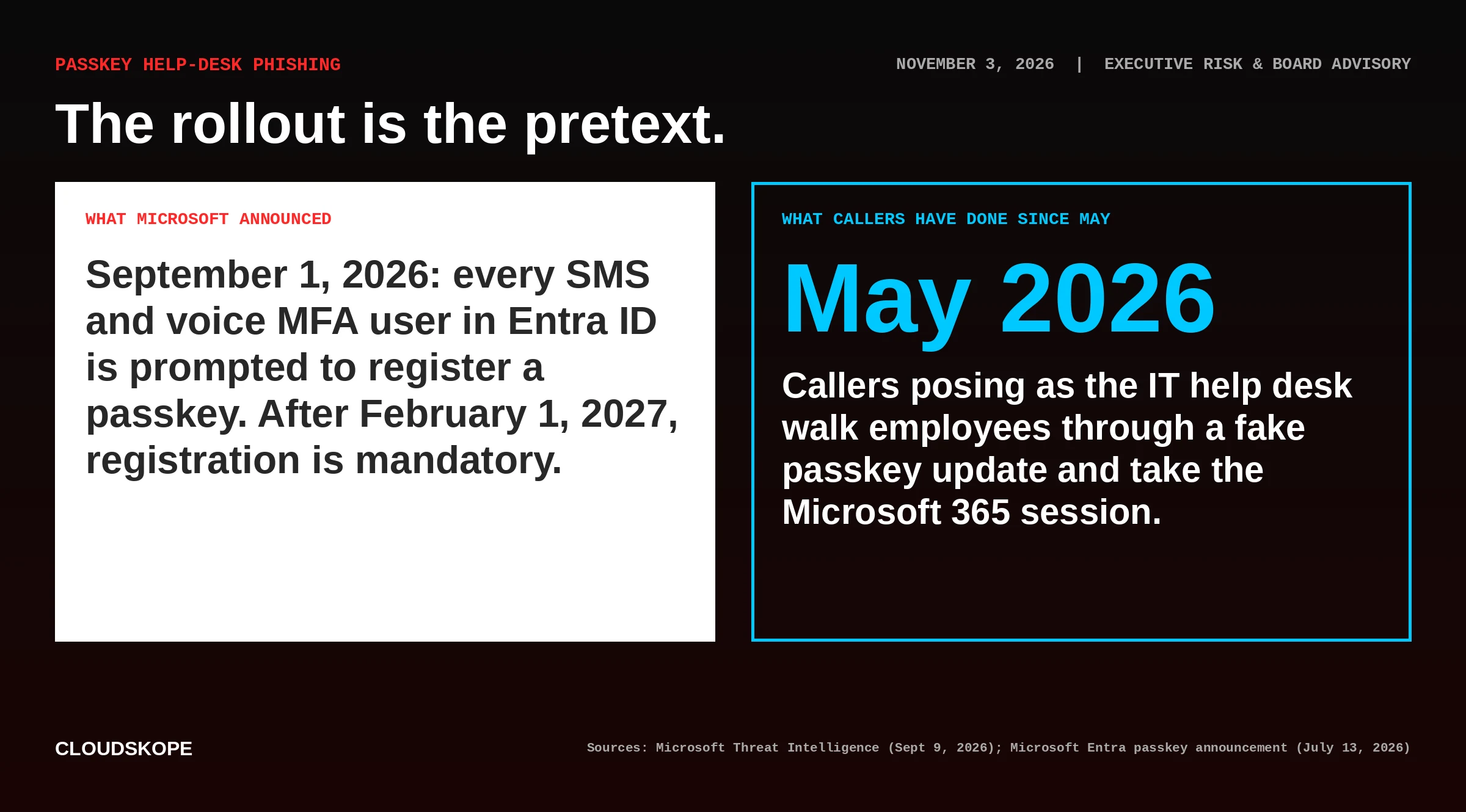
Microsoft began prompting every SMS and voice MFA user in Entra ID to register a passkey on September 1, 2026. Eight days later it published a report on criminal groups who have spent the summer calling employees, posing as the help desk, and offering to help with the passkey update.
Editor's note: Cloudskope wrote this analysis in September 2026, shortly after Microsoft's September 9 report, and dates in it (including the September 30 baseline target) are as of that writing. The rollout it describes is still under way: SMS and voice MFA users are being prompted to register passkeys now, and registration becomes mandatory after February 1, 2027.
The call
It starts with a phone call or a text to a personal mobile number. The caller knows the employee's name, title, and manager, usually from LinkedIn. They say they are from IT. There is an urgent passkey update, or an MFA migration, or an SSO change, and access will be disrupted if it is not completed today. Would the employee mind visiting a short link to finish it?
The link goes to a domain that looks like it belongs to the company. Microsoft's report lists the pattern: contoso.add-passkey[.]com, contoso.setupmypasskey[.]com, contoso.integratedsso[.]com, contoso.oskeysync[.]com. The domains are registered through Nicenic, stood up within hours, and rotated per target. What the employee sees is a Microsoft sign-in page. What is actually happening is one of two things.
In the first version, the page is an adversary-in-the-middle proxy. The employee types a real password, approves a real MFA prompt, and the attacker captures the resulting session token as it passes through. The MFA worked. It just authenticated the attacker.
In the second version, the caller reads out a short code and asks the employee to enter it at microsoft.com/devicelogin. This is the device-code flow, a legitimate OAuth mechanism built for smart TVs, conference room hardware, and printers that cannot show a browser. When the employee enters the code and approves, Microsoft issues a token to whatever client requested that code. In this case, the attacker's client. No cookie theft, no malware, no fake page. The employee authorized it on a real Microsoft domain.
Microsoft's own summary of the lure is blunt: "Despite the frequent use of passkey-themed lures, passkey enrollment is often not the actor's true objective."
Why September 1 matters
The pretext is not new. Help-desk impersonation has been the entry point for the Scattered Spider lineage for three years. What is new is the calendar.
On July 13, 2026, Microsoft announced that passkeys would become the default authentication method in Entra ID and that native SMS and voice MFA would be retired. The rollout began September 1, 2026. From that date, every user in a public-cloud Entra tenant who was enabled for SMS or voice MFA is auto-enabled for passkeys and is prompted to register one the next time they complete MFA. After February 1, 2027, registration is mandatory.
So as of two weeks ago, every employee in every Microsoft 365 tenant is receiving legitimate, Microsoft-generated prompts to set up a passkey. Many are confused by them. Some are calling their help desk to ask. And the criminal groups who built a passkey-themed pretext back in May now have a tailwind they could not have engineered themselves: their story matches the one IT is telling.
Microsoft published its report on the campaign on September 9, eight days into the rollout. Nothing in the rollout plan appears to account for it.
Who is calling
Microsoft attributes initial access to two clusters and notes that additional operators in the same ecosystem use identical tactics.
Storm-3121 conducts initial access that feeds the ShinyHunters and Falcon extortion operations. If that name is familiar to readers of this site, it should be. ShinyHunters is the group behind the EY tax-records breach we covered earlier this year, and its business model is the same here: get in through a human, take everything, extort the company, and leak if unpaid.
Storm-3032 splintered from the BlackFile group and now operates under the Helix extortion brand. Google Threat Intelligence tracks the same actors as UNC6671, and other vendors use Cordial Spider.
These are not nation-state operators. They are commercial extortion crews with a repeatable playbook and, per Microsoft, automated tooling written in Node.js and Python to run the post-compromise phase at scale.
The criminals are not phishing the passkey. They are phishing the rollout, and Microsoft's own calendar is doing their pretext work for them.
What happens after the session is stolen
This is the part of the report that should change how mid-market security teams think about Microsoft 365 compromise. The mailbox is not the prize. It is the starting point.
Step one: persistence. Within minutes of the first sign-in, the actor registers a new MFA method on the account: a phone number, an authenticator app, or a software OTP token. Microsoft's telemetry shows these registrations landing in the audit log as ordinary "Update user" events with markers like SoftwareTokenActivated. In one variant, the actor pre-registered OTP methods on previously stolen credentials days before the campaign launched, so that when the account was used, the MFA challenge was satisfied by a factor the attacker already controlled. Microsoft: "By registering an actor-controlled MFA method, the threat actor ensured that future authentication challenges could be satisfied using a factor they controlled." At that point, revoking the stolen session does nothing. The attacker just signs in again.
Step two: reconnaissance through Graph. The actor then queries the Microsoft Graph API in a specific order. Tenant profile first (/organization, /subscribedSkus) to see what the company owns. Then the directory (/users, /groups, /transitiveMembers) to map who is who. Then privilege (/directoryRoles, /roleManagement, /authentication/methods) to find admins and see how they authenticate. Then applications (/servicePrincipals, /oauth2PermissionGrants) to find every SaaS product federated behind Entra. Only then do they go to /sites, /drives, /messages, and /attachments.
Microsoft's point about detection is the one every MSP should read twice: "Microsoft Graph abuse rarely appears suspicious when viewed through a single API call." Each request is something a normal user or a normal app does. The signal is one identity walking through all six categories in sequence, in thirty minutes, from an IP it has never used before.
Step three: collection. SharePoint, OneDrive, and Exchange are pulled through REST APIs, often with a python-httpx user agent, at a deliberately controlled pace. Microsoft observed "fewer than 1,000 files or emails accessed within any one-hour period." That number is not an accident. It sits under the default thresholds most tenants would alert on, and it lets the actor run for "several hours to multiple days" without tripping anything.
Step four: the SSO layer. Because the application-discovery step already mapped every enterprise app in the tenant, the stolen identity now reaches anything federated through Entra: Salesforce, Slack, Atlassian, Google Workspace, Dropbox, SAP, Zendesk. Every integration a company added to make onboarding easier is one session away.
The unglamorous truth about the door
Read the attack chain again and notice where the actual failure is. It is not the passkey. It is not even the employee, who did what a real help desk would have asked. The failure is that the tenant accepted a device-code authorization, or accepted a session from an unmanaged device, and then accepted a new MFA method being registered from that session with no additional friction.
Every one of those is a Conditional Access decision. None of them require a new product. In my experience working on mid-market tenants, most have never made those decisions at all, because the defaults did not force them and the MSP was paid to keep things working, not to break the CEO's iPad.
The device-code flow is the clearest case. It exists for devices without browsers. In a typical 200-person professional services firm, the legitimate uses are a handful of conference-room displays and possibly a printer. Blocking it for everyone else is a single Conditional Access policy, took Microsoft one line in its recommendations to state, and remains enabled in the large majority of tenants I have looked at this year.
What the tenant baseline should look like by September 30
Microsoft's recommendations run to about twenty items. For a mid-market operator with one IT lead and an MSP, these are the five that matter most, in the order I would do them.
One. Block device-code and authentication-transfer flows in Conditional Access. Create an explicit exception group for the conference-room hardware that needs it. Everything else is denied. This closes the door the caller is trying to walk the employee through.
Two. Require compliant or hybrid-joined devices for Exchange Online, SharePoint Online, and OneDrive. If a device the company does not manage cannot get a full session, a stolen session from that device is worth far less. Where a full block is too disruptive, use the app-enforced restriction that gives unmanaged devices web-only access with no download or sync.
Three. Lock down security-info registration. Registering a new MFA method should require a fresh interactive sign-in, a managed device or a known office location, and phishing-resistant MFA. Add a second policy that blocks registration entirely when sign-in risk is elevated. This is the control that turns a stolen session into a dead end instead of a permanent foothold.
Four. Turn on Graph activity logs and mailbox auditing, and alert on two patterns. First: any sign-in flagged as unfamiliar followed within an hour by a new authentication method. Second: one identity touching three or more Graph reconnaissance categories in thirty minutes. Microsoft published the KQL for both in the September 9 report. An MSP that runs Defender XDR or Sentinel can have these live in a day.
Five. Review every service principal with Mail.Read, Files.Read.All, or Directory.Read.All, and require admin consent for new apps. The actor's application-discovery step is looking for exactly these grants. Every one that is not needed is an exfiltration path you are maintaining for them.
Then, and only then, accelerate the passkey rollout with a phishing-resistant authentication strength in Conditional Access. Passkeys are the right destination. They are just not a defense against the session theft that happens on the way there.
The help desk itself
One more control that is not a tenant setting. Microsoft's recommendation is that identity be verified through rigorous processes before any help-desk-initiated credential or MFA reset, and that every such reset generate an alert. The practical version for a mid-market firm: the help desk never initiates contact about MFA or passkeys by phone or SMS, and employees are told so in one sentence, in writing, this month. Any inbound call claiming otherwise is reported, not followed. That single sentence would have stopped every intrusion in Microsoft's report at the first step.
Patch Tuesday, same week
On September 8, the day before Microsoft's campaign report, its monthly security release fixed a record 964 to 966 vulnerabilities depending on how you count, including two Windows privilege-escalation zero-days exploited in the wild (CVE-2026-81963 in the Windows Update Stack, CVE-2026-85880 in ALPC) and a critical elevation-of-privilege flaw in Entra ID itself, CVE-2026-83941. Microsoft attributes the record count to an AI-assisted vulnerability discovery system it recently put into service; the totals were 570 in July and 400 in August.
The Entra ID bug is fixed on Microsoft's side, but the two Windows zero-days need endpoint patching, and a workstation that an attacker can escalate to SYSTEM on is a workstation where the primary refresh token can be lifted directly. A managed-device requirement in Conditional Access is only as good as the management of the device. If your MSP has not confirmed those two CVEs are deployed across the fleet, that is the first question for Monday.
What this looks like from the sponsor's chair
For a private equity firm with a dozen portfolio companies on Microsoft 365, this campaign is not twelve separate problems. It is one question asked twelve times: is the device-code flow blocked, is there a managed-device requirement on SharePoint and Exchange, and does anyone get paged when a new MFA method is registered after an unusual sign-in?
Those three answers can be pulled from any tenant in an afternoon by someone with Global Reader. They do not require the portfolio company's cooperation beyond granting the role. They produce a yes or a no. And they map directly onto the questions a cyber insurer is going to ask at the next renewal, because insurers read the same Microsoft reports.
In pre-acquisition diligence, the same three checks belong in the first-week request list alongside the SOC 2 report and the pen test. A target whose tenant still accepts device-code authorization in late 2026 is telling you something about how the rest of the environment has been run.
Questions for the board
If you sit on a board or an investment committee, you do not need to know what a device-code flow is. You need to ask five things of whoever owns the tenant and get answers in plain language.
1. As of today, can an employee authorize a sign-in on our tenant by typing a code into a Microsoft page that a caller reads to them? If yes, why, and for whom?
2. Can someone on a laptop we do not manage open our SharePoint and download files? If yes, what stops them from downloading all of it?
3. If an attacker steals a session, can they add their own phone as an MFA method without any additional check? Who would know, and how quickly?
4. Has anyone confirmed that the two Windows zero-days from September 8 are patched on every endpoint, and can they show the report?
5. Has every employee been told, in writing, that IT will never call or text them about MFA or passkeys?
An MSP or internal IT lead who can answer all five in one meeting is running the tenant well. One who needs to check and get back to you on the first question is telling you the answer.
The larger pattern
Step back from the specifics and the shape of this campaign is one we have written about before on this site. ShinyHunters did not breach EY's tax-records environment with an exploit. Scattered Spider did not take down MGM with malware. In each case a human at a help desk, or a human being impersonated as one, was the vulnerability, and the identity platform behind them was configured to trust whatever that human approved.
Microsoft's report does not name victims or give counts. It does not need to. The infrastructure list alone, more than a dozen themed domains rotated per target, and the fact that two separate extortion ecosystems adopted the same pretext independently, tells you this is working at volume.
The passkey rollout will finish. By February 2027, SMS and voice MFA will be gone from Entra and the industry will be better for it. Between now and then, every employee in every tenant is going to get a legitimate prompt to register a passkey, and some of them are going to get a phone call the same week from someone offering to help.
Whether that call works is not up to the employee. It is up to five settings in Conditional Access that most tenants have never touched.
Reporting: Microsoft Security Blog, "Passkey-themed social engineering leads to identity and cloud compromise" (September 9, 2026) and "Passkeys are the default authentication method in Entra ID" (July 13, 2026); BleepingComputer (September 8 and September 11, 2026); Tenable and SecurityWeek Patch Tuesday coverage; Google Threat Intelligence attribution as cited by Microsoft.
The passkey was designed to end phishing. The way it is being rolled out has given phishers the best pretext they have had in years, and the tenants that will lose data are the ones that treated the identity platform as something the MSP handles rather than something the board owns.
Cloudskope runs this tenant baseline review across single Microsoft 365 tenants and across PE portfolios. The three sponsor checks above are the first hour of it, and the five Conditional Access settings are the first week.