.png)


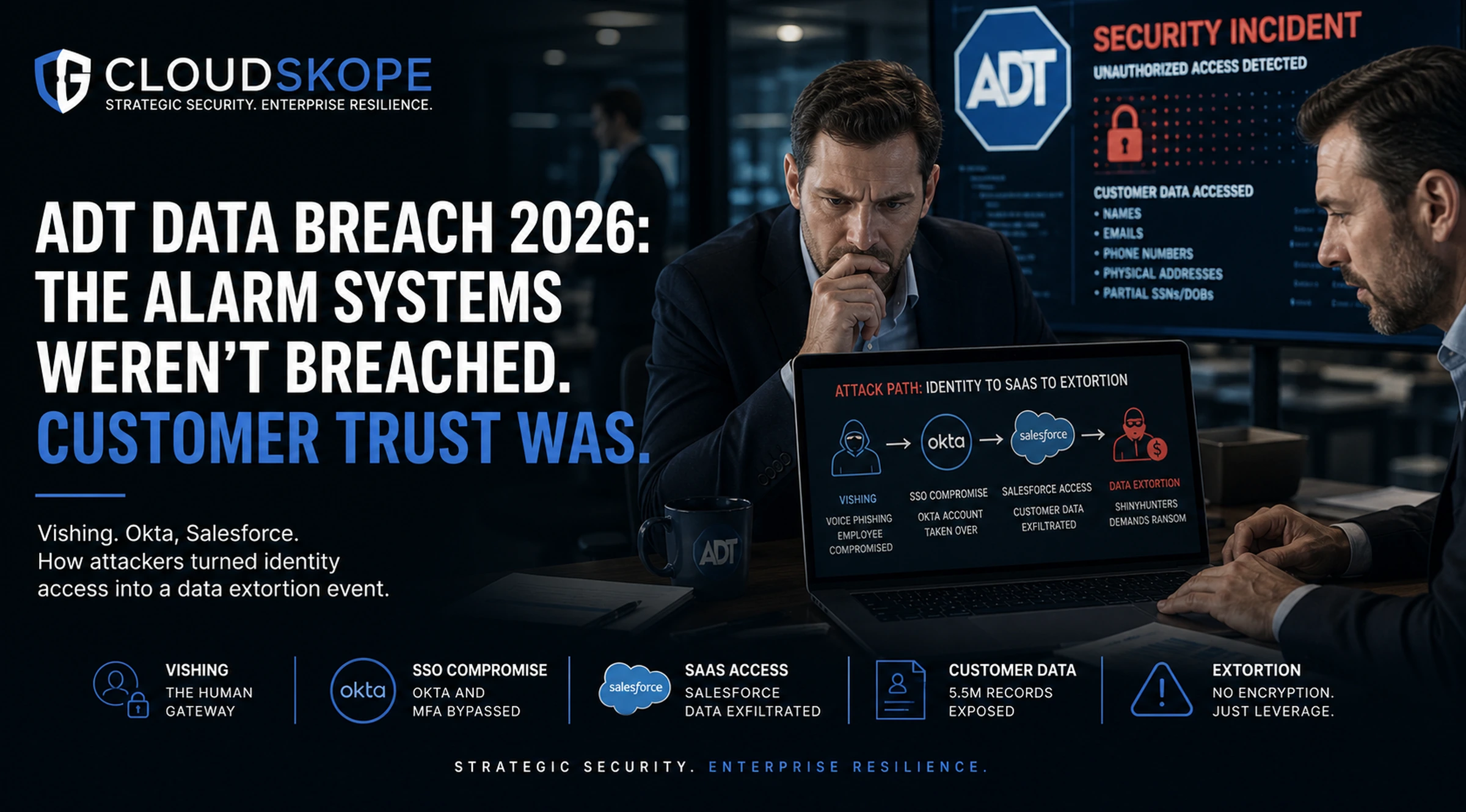
The most dangerous part of the ADT breach is not what ADT says was untouched. ADT has said customer alarm systems were not compromised, and reporting indicates payment information was not accessed. That matters. It limits part of the technical blast radius. But it does not neutralize the business problem. Because ADT is not just another company with customer records. ADT is a security company. Its customers are not buying software convenience. They are buying protection, confidence, and the belief that sensitive information connected to their homes, businesses, and routines is being handled with unusual care. That is why the ADT breach should make executives pause. The alarm systems may not have been breached. Customer trust was.
This Was Not Just a Data Leak. It Was a Trust Event.
ADT disclosed that on April 20, 2026, it became aware of unauthorized access to certain cloud-based environments. The company said it terminated the unauthorized access, activated its incident response plan, launched an investigation with third-party cybersecurity experts, and notified law enforcement. ADT’s media statement also described unauthorized access to a limited set of customer and prospective customer data.
That is the corporate incident language.
The executive translation is more direct:
A security company had customer data accessed from cloud-based systems.
Have I Been Pwned later listed the breach as affecting 5.5 million unique email addresses, along with names, phone numbers, and physical addresses. ADT also advised that in a small percentage of cases, dates of birth and the last four digits of Social Security numbers or Tax IDs were included.
That dataset matters because context matters.
A name is one thing.
A name plus phone number plus physical address plus affiliation with a home security provider is something else.
It creates risk for phishing.
It creates risk for vishing.
It creates risk for impersonation.
It creates risk for targeted scams.
It creates risk for customer anxiety.
It creates risk for brand erosion.
Even if no alarm systems were accessed, the breached data still carries unusual sensitivity because of what ADT does.
This is the point many breach writeups miss.
The value of data is not only determined by the field names in a database. It is determined by the business context around those records.
A customer address exposed from an ordinary retailer is bad.
A customer address exposed from a home security company feels different.
That is the uncomfortable lesson.
In modern cyber risk, the same data field can carry a different level of consequence depending on the business model attached to it.
The ADT breach shows why customer data cannot be valued only by category. A name, phone number, and address become more sensitive when the company holding them sells physical security and customer trust.
The Real Attack Path Is Identity to SaaS to Extortion
The most important technical lesson from the ADT incident is not malware.
It is identity.
Public reporting says ShinyHunters claimed it used voice phishing, or vishing, to compromise an employee’s Okta single sign-on account and access ADT’s Salesforce environment. ADT has confirmed unauthorized access to customer and prospective customer data, but it has not publicly confirmed every specific detail of the attack method described by the attackers. That distinction matters: the vishing-to-SaaS chain is heavily reported, but the company’s confirmed statements are narrower.
Still, the alleged chain fits a broader 2026 pattern.
Google Threat Intelligence and Mandiant have reported an expansion of ShinyHunters-branded SaaS data theft activity using sophisticated vishing and victim-branded credential-harvesting sites. These campaigns obtain SSO credentials and MFA codes, then use legitimate access to reach cloud-based SaaS applications and steal data.
That operating model is simple and dangerous:
Voice call → SSO compromise → SaaS access → data extraction → extortion.
No ransomware encryption required.
No noisy malware detonation required.
No traditional perimeter breach required.
That is why this class of attack is so difficult for executives to internalize. It does not look like the old breach model. The attacker may not be “hacking through the firewall.” They may be calling an employee, impersonating IT, capturing authentication material, registering a device, and walking through the front door with valid credentials.
The architecture problem is deeper than one breached company.
1. SSO Is a Control Plane, Not a Convenience Feature
Single sign-on is often sold internally as efficiency.
One identity.
One login experience.
One cleaner user workflow.
But from a risk standpoint, SSO is a control plane.
When it is compromised, downstream SaaS applications can become reachable with frightening speed. If Salesforce, Microsoft 365, Google Workspace, Slack, DocuSign, Dropbox, customer portals, ticketing systems, or finance tools all depend on the same identity layer, then the identity layer becomes the crown jewel.
SSO reduces friction.
It also concentrates consequence.
That is not an argument against Okta, Entra ID, Google Workspace, or any identity platform.
It is an argument against treating identity as plumbing.
Identity is now the perimeter, the control plane, and in many incidents, the breach path.
2. SaaS Platforms Are Now Data Warehouses
Salesforce is not just a CRM.
For many companies, it is a customer intelligence system.
It may contain:
- names,
- addresses,
- emails,
- phone numbers,
- sales notes,
- service history,
- customer status,
- support history,
- account ownership,
- renewal data,
- lead sources,
- partner details,
- and customer segmentation.
If identity is compromised and SaaS permissions are too broad, attackers may not need to compromise the core network.
They can go directly to the data.
That is the modern SaaS risk model.
3. Vishing Is Not “User Error.” It Is an Operational Control Failure.
Executives often hear “voice phishing” and mentally file it under employee training.
That is too simplistic.
Training matters. But vishing works because attackers exploit process ambiguity.
Who is allowed to call employees about MFA?
How do employees verify an internal IT call?
Can helpdesk staff reset MFA without step-up validation?
Can users enroll new devices too easily?
Are suspicious login attempts correlated with helpdesk activity?
Are SSO events monitored in real time?
Are SaaS exports reviewed?
Are impossible travel and new-device registration alerts operationally acted on?
Those are process and architecture questions.
A trained employee can still be manipulated if the organization has not designed verification into the workflow.
4. Extortion Has Moved Past Encryption
ShinyHunters is not primarily interesting because of the name.
The group is interesting because the model reflects where cyber extortion is going.
BankInfoSecurity reported that ShinyHunters listed ADT on its data leak blog, claimed to have stolen more than 10 million records, and later posted what it said was a large dataset. Have I Been Pwned listed the confirmed exposure at 5.5 million unique email addresses.
That is the ransomware lesson without ransomware.
Attackers no longer need to encrypt your systems to create leverage.
They can steal customer data.
They can threaten publication.
They can create customer fear.
They can trigger legal review.
They can compress executive decision-making.
They can force a company into a public trust event.
The ransom note is no longer always on a locked screen.
Sometimes it is on a leak site.
What Executives Should Learn From ADT
The ADT breach is not just a warning for home security companies.
It is a warning for any business that stores customer data in SaaS platforms, relies on SSO, and assumes that MFA plus annual compliance evidence is enough.
It is not.
1. Treat Customer Data by Context, Not Just Category
Most data classification programs treat records mechanically.
Name.
Email.
Phone.
Address.
Date of birth.
Partial SSN.
Those fields matter. But leadership should also ask:
What does this data reveal because of the business we are in?
For ADT, a customer address is not only a mailing address. It is connected to a physical security relationship.
For a healthcare provider, a patient email may imply care context.
For a wealth advisor, a customer record may imply financial status.
For a law firm, a contact list may imply legal exposure.
For a defense contractor, a vendor roster may imply operational sensitivity.
The data field is only half the risk.
The business context is the other half.
2. Harden the Helpdesk and MFA Reset Process
Vishing succeeds because attackers target human trust and weak verification.
Organizations should define strict protocols for:
- employee identity verification,
- MFA reset approval,
- device enrollment,
- helpdesk callback procedures,
- executive account changes,
- privileged account recovery,
- and suspicious login escalation.
No employee should be trained to trust a call simply because the caller sounds internal.
Verification must be engineered into the process.
3. Move Toward Phishing-Resistant MFA
SMS codes, push approvals, and user-supplied MFA codes are increasingly vulnerable to real-time social engineering.
Organizations should prioritize phishing-resistant MFA for high-risk users and systems, especially:
- administrators,
- helpdesk staff,
- Salesforce users with export rights,
- finance users,
- executives,
- developers,
- IT operations,
- and anyone with access to sensitive customer data.
Google’s reporting on ShinyHunters-style activity specifically highlights the compromise of SSO credentials and MFA codes through vishing and credential-harvesting sites.
If the attacker can talk an employee into approving access, the control is not strong enough for high-risk roles.
4. Audit SaaS Permissions Like Privileged Access
SaaS platforms should not be treated as low-risk business applications.
Salesforce, Microsoft 365, Google Workspace, Slack, DocuSign, Dropbox, ServiceNow, and similar platforms often contain operationally sensitive data.
Executives should ask:
- Who can export customer records?
- Who can access bulk data?
- Which roles are overprivileged?
- Which third-party apps have access?
- Which users have not been reviewed recently?
- Which guest users remain active?
- Which logs show abnormal access?
- Which alerts indicate mass export behavior?
SaaS is now infrastructure.
It deserves infrastructure-grade governance.
5. Monitor for Identity-to-SaaS Attack Chains
Detection should not focus only on malware.
The ADT story reinforces the importance of monitoring identity and SaaS behavior together.
Watch for:
- new MFA device enrollment,
- login from unusual geographies,
- impossible travel,
- new session from residential proxy infrastructure,
- anomalous Salesforce exports,
- mass record queries,
- unusual API activity,
- first-time device access,
- privilege changes,
- helpdesk resets near suspicious logins,
- and access to sensitive objects outside normal patterns.
The identity event is often just the beginning.
The SaaS activity tells you whether the attacker found the data.
6. Build an Extortion Response Plan Before Data Is Posted
Extortion is not the same as encryption.
A company needs a playbook for:
- data validation,
- breach counsel engagement,
- law enforcement notification,
- customer communications,
- regulator timelines,
- cyber insurance notice,
- board updates,
- dark web monitoring,
- identity protection offerings,
- and executive decision rights.
The worst time to design that process is after the attacker publishes samples.
7. Stop Treating Vendor Questionnaires as Risk Management
The current post correctly criticizes checklist thinking, but the stronger point is this:
A SOC 2 report, vendor questionnaire, or policy document does not prove that identity controls, SaaS permissions, and helpdesk workflows will hold under active social engineering.
Risk management has to move from annual evidence collection to continuous control validation.
The right question is not:
Do we have controls?
The right question is:
Would those controls interrupt this attack path?
Related Reading
The ADT breach is not just a security-company problem. It is an identity, SaaS, and customer-trust problem. The alarm systems may not have been breached. But the business lesson is clear: trust is now part of the attack surface.
CloudSkope helps leaders audit identity, SaaS, and customer-data exposure before attackers turn ordinary records into extortion leverage. We analyze SSO, MFA, Salesforce, vendor access, and helpdesk workflows, then remediate the control gaps that allow vishing to become a breach path. We help you protect customer trust with defensible identity governance, SaaS monitoring, and executive-ready response plans.