.png)


UniFi Dream Machine Beast Review 2026: Enterprise Gateway Comparison vs Fortinet, Cisco & Palo Alto
UniFi Dream Machine Beast: A Bold 2026 Push into Enterprise Gateways
Yesterday, Ubiquiti officially unveiled the UniFi Dream Machine Beast (UDM-Beast) — the most ambitious cloud gateway the company has ever shipped. For Private Equity sponsors and F100 CIOs who are actively evaluating infrastructure modernization, post-M&A integration, or Zero Trust transformations, this launch is impossible to ignore.
UniFi has spent the last seven years methodically climbing from prosumer darling to a legitimate mid-market contender. The Beast is not an incremental refresh. It is a deliberate, high-stakes move into territory long dominated by Fortinet, Cisco, and Palo Alto Networks.
Here is the ground truth: what the UDM-Beast actually delivers, where it sits against the incumbents, and when (and when not) sophisticated buyers should consider it in 2026.
The UDM-Beast is in a league of its own on raw throughput, port density, and client scale. It finally gives mid-market and lower-enterprise buyers the performance headroom they have been asking for — without the traditional enterprise licensing tax.
The Rapid Growth of the UniFi Gateway Ecosystem (2019–2026)
UniFi’s gateway story began in 2019 with the original Dream Machine — a single device that combined routing, switching, Wi-Fi control, and NVR functionality under one license-free console. It was an instant hit with teams exhausted by multi-vendor complexity and recurring licensing costs.
Key evolutionary milestones:
- 2019 — UDM and UDM-Pro launch: rack-mountable performance at consumer prices.
- 2022 — UDM-SE introduces integrated PoE switching and higher-speed WAN ports.
- 2024–2025 — UDM-Pro Max doubles RAM, adds RAID storage, and pushes deeper into mid-market surveillance and multi-site deployments.
- April 2026 — UDM-Beast arrives as the hyperscale-class flagship.
Today, the Dream Machine family powers hundreds of thousands of networks globally. The consistent value proposition has been simple and powerful: single-pane-of-glass management, zero recurring licensing fees, rapid feature velocity via UniFi OS, and exceptional price/performance.
With the Beast, Ubiquiti is no longer content to play in the prosumer and small-enterprise space. It is now targeting environments that demand 10G/25G backbone performance, high client density, and storage-intensive workloads (NVR + NAS) — all while preserving the license-free model that has been its biggest differentiator.
UniFi Dream Machine Lineup Comparison (April 2026)
💡 Key Insight: The new UDM-Beast is in a league of its own on raw throughput, port density, and client scale — finally delivering the performance headroom mid-market and lower-enterprise buyers have been asking for.
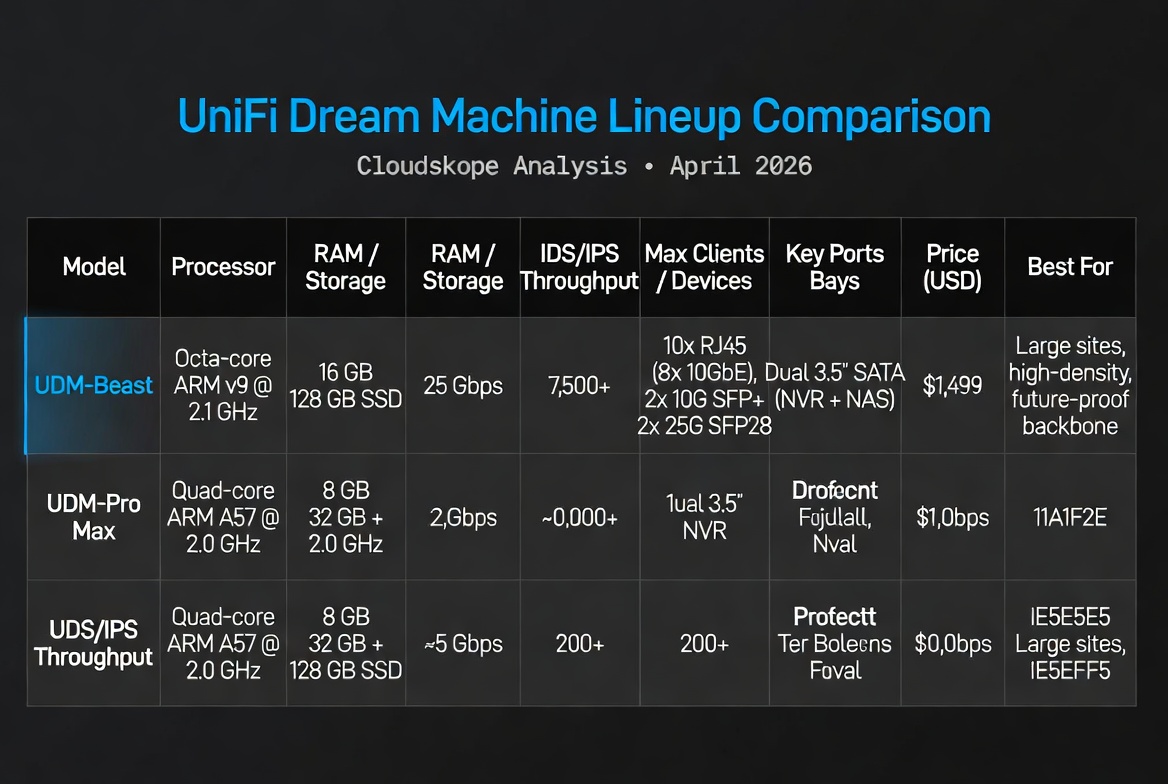
The Beast stands out dramatically:
- Octa-core ARM v9 processor @ 2.1 GHz + 16 GB RAM + 128 GB SSD + dual 3.5" SATA bays.
- 25 Gbps IDS/IPS throughput — roughly 5× the capability of the Pro Max.
- Massive port density: 8× 10GbE RJ45 + additional multi-gig ports + 2× 10G SFP+ + 2× 25G SFP28.
- Designed for high-density, future-proof backbones and large-scale surveillance/NVR deployments.
This is not “prosumer hardware in a rack.” It is a purpose-built enterprise gateway that finally matches the port speeds and client scale many organizations have needed for years.
Where the UniFi Beast Sits Against Fortinet, Cisco, and Palo Alto
This is the question every sophisticated buyer is asking: Is the Beast truly “enterprise ready,” or is it still a prosumer device wearing a rackmount chassis?
Where UniFi now competes aggressively (and wins on TCO):
- Price/Performance Leadership — At $1,499 with 25 Gbps IDS/IPS and zero licensing fees, the Beast undercuts equivalent Fortinet FortiGate, Cisco Firepower, or Palo Alto PA-Series models by 60–80% on 3–5 year TCO.
- True Unified Platform — Gateway + switches + APs + cameras + NVR under one console. No more stitching FortiManager + FortiAnalyzer or Firepower Management Center.
- High-Speed Native Ports — 25G SFP28 and dense 10GbE make it ideal for modern backbone, AI/camera, or high-throughput edge deployments.
- Shadow Mode / VRRP HA and license-free model — massive advantages for PE portfolio companies laser-focused on OpEx control.
Where it still lags the incumbents (honest assessment):
- Security Efficacy & Threat Intelligence — Palo Alto and Fortinet remain leaders in independent testing (Gartner Magic Quadrant, NSS Labs, MITRE ATT&CK). Their AI-driven prevention, sandboxing, and global threat feeds are deeper and more mature. UniFi’s built-in threat protection is capable for the price but not yet in the same league.
- Enterprise Management & Support — Cisco and Palo Alto offer mature centralized orchestration, SLAs, professional services, and deep ecosystem integrations. UniFi support is still community-first; enterprise support contracts exist but are relatively new.
- SD-WAN & SASE Maturity — Fortinet’s Security Fabric and Cisco’s SD-WAN are battle-tested at global scale. UniFi has strong routing/VPN capabilities but lacks carrier-grade orchestration and advanced SASE features.
- Compliance Depth — Highly regulated verticals (finance, healthcare, federal) still favor Palo Alto and Fortinet for broader FIPS, Common Criteria, and FedRAMP certifications.
TCO Example (3-Year Horizon for a 2,000-user Site)
- UniFi Beast stack: ~$1,499 (hardware) + minimal support = ~$18K–$25K total.
- Equivalent Fortinet/Cisco/Palo Alto: $8K–$15K hardware + $25K–$40K licensing/support = $45K–$70K+.
The gap is real — and it widens with every portfolio company you add.
Implications for Private Equity Sponsors and F100 CIOs
For PE firms, the Beast changes the calculus in two critical areas:
- M&A Technical Due Diligence — UniFi deployments are now appearing more frequently in portfolio companies. The Beast makes these environments far more defensible at scale — provided identity, segmentation, logging, and Zero Trust controls are hardened.
- Post-Close Integration & Value Creation — Rapid, low-cost standardization across portfolio companies is now more achievable. The license-free model accelerates EBITDA protection and reduces integration black holes.
For F100 CIOs, the Beast is an excellent edge or branch-office play — or a cost-effective core for mid-tier sites — when paired with Palo Alto or Fortinet at the data center for defense-in-depth.
Hybrid Strategy Recommendation (Cloudskope View):Use the UDM-Beast (or Pro Max) for edge routing, high-speed LAN, and unified management. Keep Palo Alto/Fortinet at the core for advanced threat prevention and compliance. This hybrid approach delivers the best of both worlds: simplicity and TCO at the edge, enterprise-grade security at the core.
Potential Pitfalls & Hardening Checklist
When evaluating the Beast:
- Ensure proper identity/privilege management (Entra ID / Zero Trust integration).
- Implement network segmentation and micro-segmentation early.
- Enable comprehensive logging and forward to a SIEM or MDR platform.
- Plan for firmware velocity — Ubiquiti moves fast, which is both a feature and a risk.
We include these exact checks in every M&A technical due diligence engagement.
Where the UniFi Beast Sits Against Fortinet, Cisco, and Palo Alto
Strengths where UniFi now competes aggressively:
- Price/Performance King — $1,499 with 25 Gbps IDS/IPS and zero recurring license fees undercuts equivalent enterprise models by 60–80% on 3–5 year TCO.
- True unified platform — gateway + switches + APs + cameras + NVR in one interface.
- Native high-speed ports — 25G SFP28 and dense 10GbE ready for modern backbone and AI workloads.
- License-free model — massive differentiator for PE portfolio companies watching OpEx.
Where it still lags the incumbents (honest assessment):
- Security efficacy and threat intelligence depth
- Mature enterprise management, SLAs, and professional services
- Carrier-grade SD-WAN and SASE orchestration
- Depth of compliance certifications in highly regulated verticals
____
Disclaimer:
This article represents the independent analysis and opinion of Cloudskope, an elite, vendor-neutral cyber risk and infrastructure advisory firm. Cloudskope is not affiliated with, sponsored by, or endorsed by Ubiquiti Networks, Fortinet, Cisco Systems, Palo Alto Networks, or any other vendor mentioned. All competitive comparisons, TCO estimates, and recommendations are based on publicly available data and our professional experience. Prices and specifications are approximate and subject to change. This content is for informational purposes only and does not constitute professional advice.
Sources & Credits
- UniFi Dream Machine Beast specifications, features, and announcement: Official Ubiquiti Networks blog – “Introducing Dream Machine Beast” (April 29, 2026)
- Hardware imagery: Adapted from official Ubiquiti product photography
- All comparison data and performance numbers: Verified against Ubiquiti technical specifications as of April 30, 2026
- Competitive benchmarks: Public Gartner reports, NSS Labs, MITRE ATT&CK evaluations, and industry TCO analyses (2025–2026)
Related Reading
The UniFi Dream Machine Beast represents a genuine inflection point in the gateway market. For the first time, mid-market and lower-enterprise organizations — and especially Private Equity-backed companies — have access to hyperscale-class performance, high-speed ports, and unified management without the crushing weight of perpetual licensing fees. It does not replace Fortinet, Cisco, or Palo Alto in every scenario. What it does is force the entire industry to reconsider what enterprise infrastructure should cost and how simple it can be to operate. Sophisticated buyers now have a real choice: continue with the traditional high-TCO enterprise stack, or adopt a hybrid model where the Beast handles edge and unified operations while proven leaders secure the core. The decision ultimately comes down to one question: Are you optimizing for long-term valuation protection and operational agility, or are you still buying based on legacy brand comfort? At Cloudskope, we help PE sponsors and F100 CIOs answer that question with Ground Truth — through independent technical due diligence, architecture reviews, and forceful remediation that turns infrastructure decisions into measurable financial outcomes. The Beast is here. The real question is whether your stack is ready for what comes next.
Ready to pressure-test whether the Beast (or any UniFi gateway) belongs in your stack? Drop us a note at advisory@cloudskope.com or book a confidential 30-minute briefing. We’ll run the numbers for your specific environment.

.png)