.png)
Take-Two Lost $2.8 Billion. The Hacker Cashed Out $250,000. Nobody Ever Sent a Ransom Note.


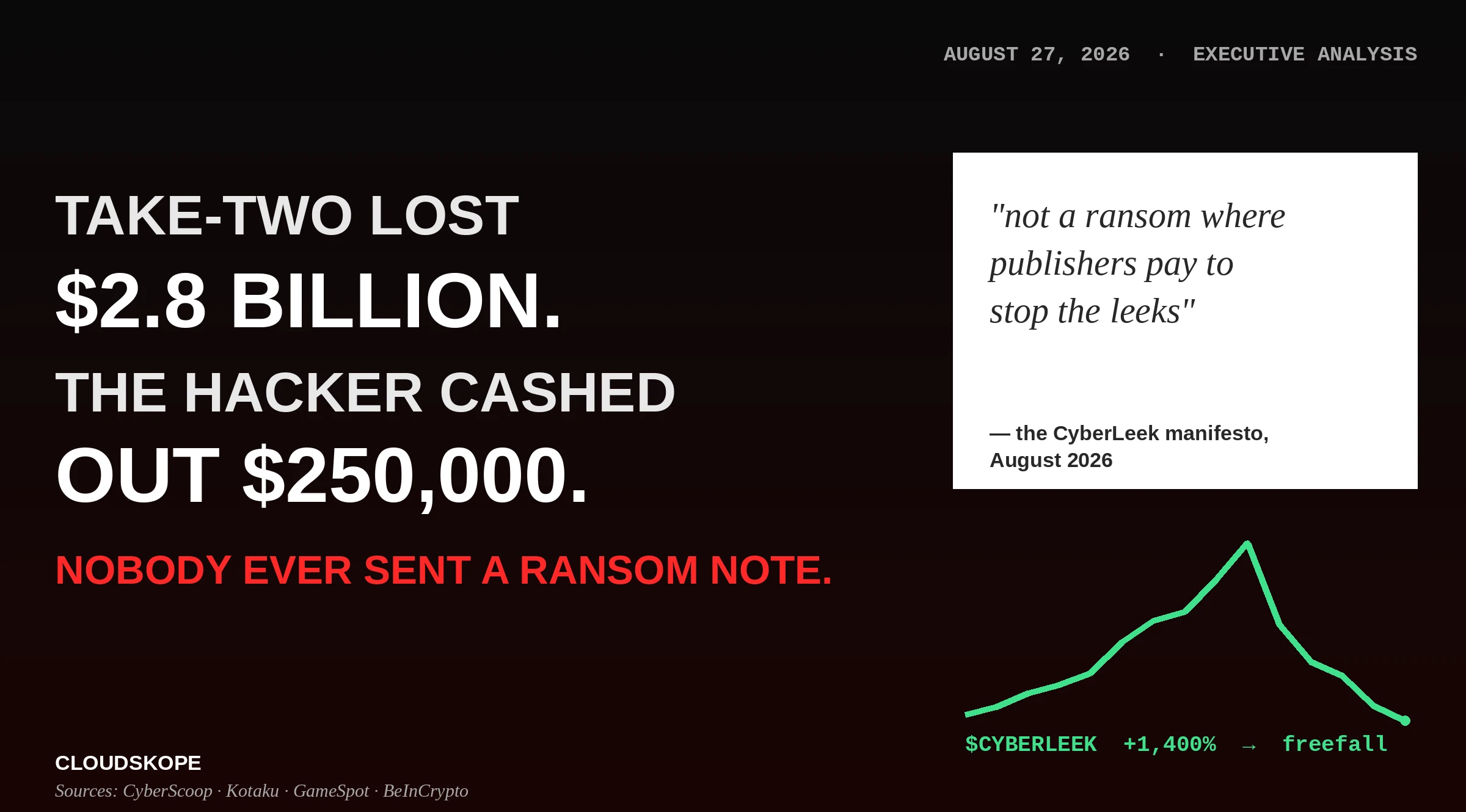
For nine days, an anonymous actor called CyberLeek leaked the most anticipated video game in history, watermarked every clip with a QR code for a memecoin, and walked away with roughly $250,000. Take-Two Interactive was never asked to pay a dime.
Every incident response plan on earth shares one quiet assumption: at some point, the attacker calls you.
They encrypt your systems and send a note. They steal your data and open a negotiation. They post a countdown clock and wait for your lawyers. The entire apparatus of modern breach response, the ransom negotiators, the cyber insurance policies, the board-approved we do not negotiate posture, is built around a counterparty who needs your money.
Between August 18 and August 27, 2026, someone demonstrated that the counterparty no longer needs you at all.
The timeline, assembled from reporting by CyberScoop, Kotaku, GameSpot, and on-chain analysts tracking the wallets involved.
On August 18, an anonymous persona calling itself CyberLeek began publishing unreleased footage of Grand Theft Auto VI, Rockstar Games' flagship title and, by most commercial measures, the most anticipated entertainment product of the decade. The leaks arrived almost daily: fifteen clips over roughly nine days, showing flying sequences, driving, combat, and map detail from an in-development build.
One clip removed any doubt about the depth of access. The protagonist fires rounds into a wall, and the bullet holes spell out LEEK. That is not a smuggled screen recording. That is real-time control of a playable build, per analysis reported by GameSpot and others.
Take-Two Interactive, Rockstar's parent, reportedly lost $2.8 billion in market value in the days that followed, ahead of a planned reveal event and a November 19 release date. The company's response signaled where it believes the wound came from: per CyberScoop, Take-Two is approaching the matter like an insider threat investigation. The files indicate either a hacker with access to Rockstar's most sensitive systems, or an employee who handed them over. The company has subpoenaed Microsoft, Discord, and X for account and device data, with a September 4 deadline.
Now the part that should reorganize how boards think about extortion.
CyberLeek never sent a ransom demand. The group said so explicitly, insisting this was not a scheme where publishers pay to stop the leeks. The closest thing to a demand was a taunt: roughly $165,000 in Monero, framed as a contact fee just to open a conversation about buying advertising space on future leaks.
Instead, every leaked clip carried a watermark and a QR code pointing to $CYBERLEEK, a memecoin launched on Solana around August 15, three days before the first leak. The leaks were not the product. The leaks were the marketing. The token was the product.
It worked. The coin spiked more than 5,000% in its early days, hit 24-hour gains above 1,400% at the peak of the news cycle, and reached a market capitalization near $22 million with daily trading volume that at times exceeded $112 million. A liquid market had formed, overnight, around one company's security failure.
Then, in the early hours of August 27, hours before Rockstar's official reveal aired on Netflix, on-chain analysts documented CyberLeek transferring roughly $250,000 out. The coin went into freefall. The leaks, as of this writing, have stopped.
Total sum extorted from Take-Two: zero. Total sum extracted from the situation: a quarter of a million dollars, paid voluntarily by strangers, plus $2.8 billion in shareholder value destroyed as collateral.
One more detail worth preserving, because it will show up again in future incidents. CyberLeek claimed that complete playable builds of the game had been distributed across global servers, rigged to auto-release if the group was taken offline. A dead-man switch. The claim traveled everywhere. A subsequent fact-check found the Notice to Rockstar screenshot underpinning that specific threat was fabricated. The leverage was real footage. The doomsday device was theater.
The extortion economy just stopped needing the victim to pay. The market paid instead.
The industry has seen Grand Theft Auto VI leak before, and the comparison is the whole point.
In September 2022, a teenager affiliated with the Lapsus$ group posted roughly 90 clips of the same game after compromising Rockstar's internal Slack. He was arrested within days, continued hacking from a hotel room using a Fire TV Stick while on bail, and was ultimately handed an indefinite hospital order by a UK court. The 2022 model was recognizable: intrusion, extortion attempt, law enforcement, consequence. The attacker needed Rockstar to engage, and when Rockstar would not, the attacker had nothing to sell.
The 2026 model needed no engagement. It needed an audience. And GTA VI has the largest audience in entertainment.
That difference invalidates a set of assumptions that most incident response plans, insurance policies, and board postures currently treat as load-bearing. Six of them, specifically.
One. The assumption that the attacker needs you to pay. Ransom negotiation retainers, extortion playbooks, and communications trees all presume a counterparty seeking dialogue. CyberLeek's only price tag was for ad space, and it read as a joke because it was one. When the attacker's payout comes from the crowd, your negotiating position is not weak. It is nonexistent. There is no table.
Two. The assumption that refusing to negotiate starves the attacker. We do not pay is a sound principle, and after this month, an incomplete one. Take-Two paid nothing, exactly per doctrine, and the attacker was paid anyway, by a market that materialized around the spectacle. Refusal starves an extortionist. It does not starve a promoter.
Three. The assumption that cyber insurance maps to the loss. Policies price ransom reimbursement, forensics, business interruption, and notification costs. Nothing in a standard tower prices billions in market capitalization evaporating while an attacker monetizes the attention on a blockchain your insurer has never heard of. The loss vector and the coverage no longer describe the same event.
Four. The assumption that the crown jewels are customer data. No Social Security numbers were stolen here. No passwords. The asset was unreleased intellectual property and control of a launch narrative, and it proved worth $2.8 billion of somebody else's money. Any company sitting on a pre-launch product, a pending announcement, or an exit narrative holds the same class of asset. Most have never inventoried it as one.
Five. The assumption that insiders are an HR problem. The access pattern here, a playable build under live control, points inward, which is precisely why Take-Two's first legal moves targeted the platforms where an insider would talk: Microsoft, Discord, X. Insider risk in 2026 is not a disgruntled employee stealing a contact list. It is a single credentialed human converting your most valuable unreleased asset into a liquid instrument. The controls that catch it are access governance and monitoring, not exit interviews.
Six. The assumption that an attacker's claims can be repriced at face value. The fabricated dead-man switch matters as much as the real footage. Incident theater is no longer exclusive to vendors minimizing a breach. Attackers now stage-manage upward, inflating what they hold to move markets, and in this case a token price, in real time. Verification before reaction is now a fiduciary discipline, not a technical one.
None of these six is a video game problem. The video game was simply the first asset class with an audience large enough to prove the model works.
The place this lands hardest is not the gaming press. It is the deal room.
Private equity diligence prices customer data exposure, ransomware downtime, and regulatory tail risk. It has a vocabulary for all three. It has no line item for the scenario Take-Two just lived: a third party monetizing your unreleased asset against your own market value, without ever contacting you, using rails that did not exist when your policies were written.
Consider what the target profile looks like. A portfolio company eighteen months from exit, with a product launch that anchors the sale narrative. A sponsor-backed pharma asset with trial results pending. A consumer brand with a drop calendar. In every case, the un-announced thing is the value. And in every case, one insider with build access, or one compromised collaboration platform, converts that value into someone else's trade. The 2022 Rockstar breach came through Slack. The 2026 one, per Take-Two's own subpoenas, ran through Discord and adjacent platforms. The collaboration layer is the exfiltration layer.
There is also a dimension here that regulators have not caught up with, and boards should not wait for them. For nine days there existed a liquid, high-volume market whose price action tracked one public company's security failure. Anyone, including anyone with advance knowledge of the next leak, could trade it. Call it what it is: a mechanism for shorting a company's misfortune without touching its stock. The securities implications of breach-linked tokens will take years to litigate. The exposure exists today.
Questions worth putting on the record at the next board or portfolio review.
Which of our unreleased assets, product, deal, announcement, would move our valuation if leaked, and who can reach them? Do our insider risk controls cover the collaboration platforms where builds, decks, and data rooms actually live? Does our incident response plan have a branch for an attacker who never makes contact, and who is monetizing in public while we deliberate in private? Does our cyber insurance respond to market-cap loss and IP leak monetization, or only to the 2020 loss vectors it was priced on? And if a token appeared tomorrow trading on our misfortune, who in the company would even be watching?
The uncomfortable summary for any executive reading this: Take-Two did most things right. It refused to engage, moved fast on legal process, and treated the insider hypothesis seriously. It still lost $2.8 billion in market value, its launch narrative, and nine days of control. Doing everything right within the old model is no longer the same thing as being protected.
Reporting: CyberScoop on the extortion playbook and Take-Two's insider-threat posture; Kotaku and GTAForums on-chain analysis of the August 27 cash-out; GameSpot on the playable-build evidence; BeInCrypto and CryptoRank on token price action, the fabricated dead-man-switch screenshot, and the subpoenas to Microsoft, Discord, and X. The scale of CyberLeek's proceeds and the attribution of wallet activity are analyst assessments and remain unverified by Take-Two.
Take-Two will ship its game, and the $CYBERLEEK holders left holding the bag will be a footnote. What will not be a footnote is the model: extortion that never asks the victim for anything, paid out by an audience, settled on-chain, gone before the subpoenas land. It has now been proven at the largest scale in entertainment. The next operator will not pick a video game.
Cloudskope advises boards and private equity deal teams on exactly this class of exposure: which unreleased assets would move your valuation if leaked, who can reach them, and whether your insider risk and incident response programs have a branch for an attacker who never calls. That is the work of cyber due diligence when the crown jewels are not customer data.