Your Cyber Budget Is a Number. Your Cyber Risk Is a Distribution. CFOs Keep Confusing the Two.


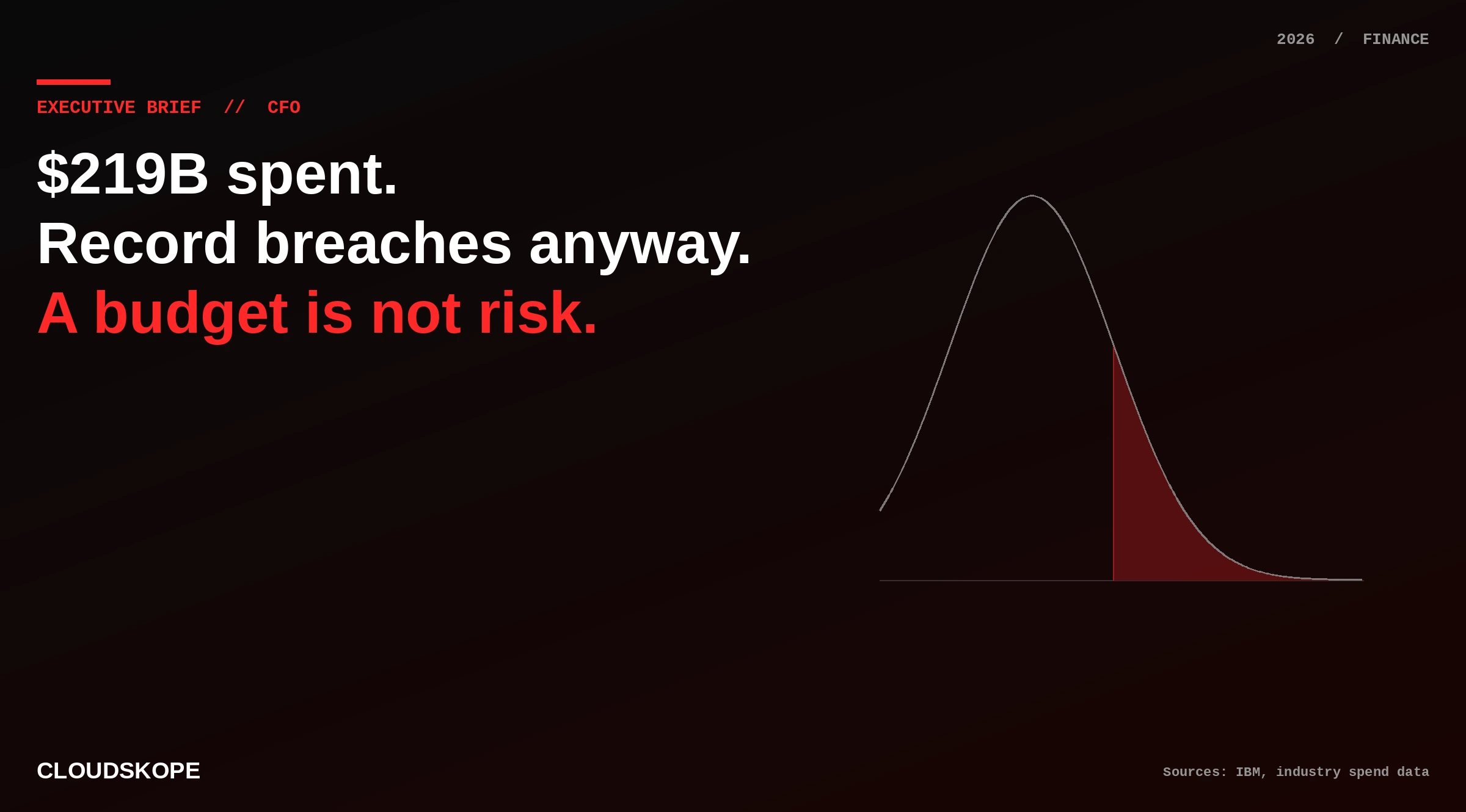
In 2025, global cybersecurity spending hit a record $219 billion, in a year that also set a record for breaches. The two facts are not a contradiction. They are the clearest evidence that CFOs are measuring the wrong thing: a budget is a single number, but cyber risk is a distribution, and confusing the two is the most expensive mistake in the category.
In 2025, the world spent about $219 billion on cybersecurity, the most in history. The same year set a record for major breaches. If spending and safety moved together, that should be impossible. It is not impossible, and the reason it is not is the single most useful thing a CFO can understand about this category.
Cybersecurity spend does not buy safety. It buys a change in the probability and severity of loss. A budget is a point. Risk is a curve, a distribution of outcomes from nothing happened this year to we are on the front page and in litigation. The job of the budget is not to be big or small. It is to move the shape of that curve, pulling the bad tail in.
Most cyber-budget conversations never get there. They get stuck on a worse question: are we spending enough? That question has no answer, because "enough" is undefined without a loss distribution to measure against. A company can spend twice the industry average and still be wide open, if the spend went to tools that look impressive in a demo and miss the way breaches actually happen. We wrote about exactly that gap in our analysis of audited, compliant companies that got hacked anyway.
A cyber budget is a single number. Cyber risk is a distribution of possible losses. The CFOs who get this right stop asking 'are we spending enough?' and start asking 'what does this dollar do to the shape of the curve?'
Three questions that reframe the budget
A CFO does not need to become a security engineer. They need to ask three questions that turn a spend debate into a risk decision.
- What does this dollar do to the loss distribution? Every proposed line item should map to a specific way the company loses money, and a defensible estimate of how much it reduces the probability or severity. Phishing-resistant MFA, for instance, directly counters the token-theft and help-desk attacks behind most 2026 breaches. A tool that does not map to a named loss is buying comfort, not coverage. This is the discipline of cyber risk quantification.
- Where does our money go versus where do breaches happen? Budgets tend to cluster on the audited, well-understood core. Breaches increasingly happen at the edge: a third-party integration, a misconfigured cloud page, an OAuth token. The 2025 TransUnion breach exposed 4.4 million records through a support app, not the core credit database the company spends most of its budget protecting. Misalignment between spend and exposure is the most common and most expensive budgeting error.
- What is the residual risk, and have we priced it? No budget drives risk to zero. The remaining tail is either retained or transferred. Cyber insurance is the transfer mechanism, and its exclusions are a CFO document, not an IT one. The residual that insurance will not cover is a number the finance function should know and own.
The CFO's actual leverage
The most valuable thing a CFO brings to this category is not budget authority. It is the habit of refusing vague numbers. Finance does not accept "we need more" on any other line. It asks what the money buys, what the return is, and what happens if it is cut. Cyber should be held to the same standard, and when it is, the conversation improves immediately.
A defensible cyber budget can be explained three ways: to an auditor, who wants to see controls mapped to risks; to an insurer, who prices the residual; and to an acquirer, whose cyber risk assessment in diligence will test whether the spend was real or theater. If the budget cannot survive all three conversations, the problem is not the size of the number. It is that the number was never tied to risk in the first place.
The companies that spend well in this category are not the ones that spend the most. They are the ones whose CFO stopped asking whether the budget was big enough and started asking what each dollar did to the shape of the curve.
The right cyber budget is not the largest one the board will approve. It is the one a CFO can defend to an auditor, an insurer, and an acquirer using the same sentence.
Cloudskope helps CFOs and boards translate cyber spend into risk reduction: where the budget actually moves the loss distribution, where it is buying comfort instead of coverage, and what a defensible number looks like to an auditor, an insurer, and an acquirer.